Gamma Delphini (Al Salib)
Gamma Delphini (Al Salib) is a double star in the constellation Delphinus, magnitude 4.4.
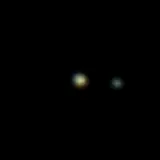
An orange star and a lime-tinted partner on a 3,000-year orbit, newly named after an Indian lunar mansion.
Here the heavier star is already showing its age. About twice the Sun’s mass, it has used up the hydrogen in its core and swollen into an orange subgiant. Its lighter partner is still a steady yellow-white star, about 1.8 billion years old. Observers have likened the colours to orange and lime.
Their orbit is extremely elongated. In one lap of about 3,250 years they swing from roughly 40 times Earth’s distance from the Sun out to 600 times. Christian Mayer first found the pair double, and William Herschel observed it on 27 September 1779.
In 1999 astronomers suggested that a planet of at least 0.7 Jupiter masses might be tugging the brighter star every 1.44 years. The wobble is there, but the planet has never been confirmed.
Gamma Delphini (Al Salib) is 120 light-years away: the light we see from it set off around 1905, around the time the Wright brothers made the first powered flight.
Did you know?
- Named in 2026. In July 2026 the IAU named the fainter star Dhanishta, after one of the 27 nakshatras, or lunar mansions, of Indian astronomy. Its asterism matches the Dolphin.
- Closing in. Early measurements put the two stars 12″ apart; by 2019 the gap had shrunk to under 9″ as they move along their long orbit.
How big is it?
512 Suns could fit inside it. Its main star is 8 times as wide as the Sun — about 11 million km across. It gives off as much light as 30 Suns. It has 1.3 times the Sun’s mass. Its companion star is at least 324 times Earth’s distance from the Sun away — 11 times as far as Neptune is from the Sun.
A lovely pair in Job's Coffin, the diamond of Delphinus. Its components (magnitudes 4.4 and 5.0; spectral types K1 IV (orange) and F7 V (yellow-white)) lie 8.8″ apart at PA 266° (measured 2025).
When and where to see it
It is best placed in the evening sky around September, when it crosses the meridian at about 10 pm local time (around midnight in August). It can be seen from everywhere north of 74°S and never sets north of 74°N.
At its highest it stands 56° up from 50°N, 71° up from 35°N, 74° up from the equator, 39° up from 35°S.
Facts
- Type
- Double star
- Constellation
- Delphinus
- Designations
- Al Salib, γ Del, γ² Del, Gamma² Delphini, γ¹ Del, Gamma¹ Delphini, 12 Del, 12 Delphini, STF 2727, HIP 102532
- Magnitude
- 4.4
- Position
- RA 20h 46.7m, Dec +16° 7′ (J2000)
- Distance
- 120 light-years
- Discovered
- Christian Mayer, Later observed by William Herschel in 1779
Open AstroPilot to see when Gamma Delphini (Al Salib) is highest tonight from your location, how easy it is with your telescope or binoculars, and an eyepiece view.