Eta Persei (Miram)
Eta Persei (Miram) is a double star in the constellation Perseus, magnitude 3.8.
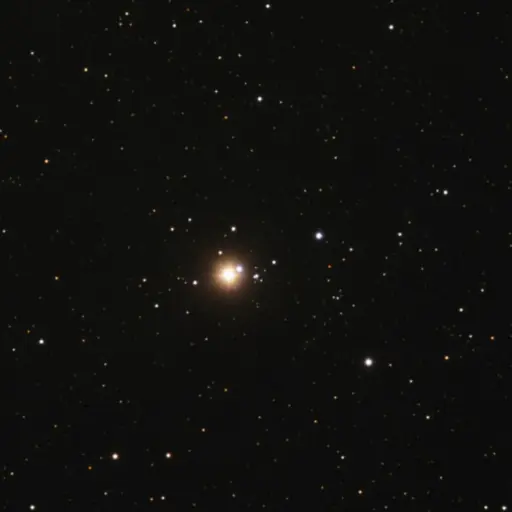
An orange supergiant thousands of times brighter than the Sun, with a name whose origin no one knows.
Swap the Sun for Eta Persei and Mercury and Venus would vanish inside it. This ageing supergiant has swollen enormously and now pours out around 7,500 times as much light as the Sun, from a surface cooler than the Sun’s — around 4,100 kelvins, which gives it its warm orange glow.
Its light reaches us dimmed: dust between the stars steals almost half a magnitude of its brightness on the way.
Catalogues list several companions near it on the sky, but only one, an eighth-magnitude star, appears to lie at the same distance. Whether any of them really belongs to Eta Persei is still unclear.
Eta Persei (Miram) is 1,000 light-years away: the light we see from it set off around 1030, around the time Chinese astronomers recorded the supernova that made the Crab Nebula.
Did you know?
- A name from nowhere. Eta Persei mysteriously picked up the name Miram in the 20th century, from no known source. The IAU nonetheless made it official in 2017.
- The Celestial Boat. In Chinese astronomy it is the first star of Tiān Chuán, the Celestial Boat, an asterism that includes Mirfak, the brightest star of Perseus.
- Segment of Perseus. With Delta, Psi, Sigma, Alpha and Gamma Persei it forms a group of stars that has been called the Segment of Perseus.
How big is it?
In the Sun’s place, it would swallow the orbits of Mercury and Venus. Its main star is 173 times as wide as the Sun — about 240 million km across. Light takes 13 minutes to cross it; it crosses the Sun in under five seconds. For all its size it holds only 8 Suns’ worth of matter: on average it is thinner than the air you breathe. It gives off as much light as 7,510 Suns. Its companion star is at least 8,310 times Earth’s distance from the Sun away — 276 times as far as Neptune is from the Sun.
A cool supergiant with a faint bluish companion. Its components (magnitudes 3.8 and 8.5; spectral types M3 I (orange-red) and B9 V (blue-white)) lie 27.1″ apart at PA 301° (measured 2024).
When and where to see it
It is best placed in the evening sky around December, when it crosses the meridian at about 10 pm local time (around midnight in November). It can be seen from everywhere north of 34°S and never sets north of 34°N.
At its highest it stands 84° up from 50°N, 69° up from 35°N, 34° up from the equator, below the horizon from 35°S.
Facts
- Type
- Double star
- Constellation
- Perseus
- Designations
- Miram, η Per, 15 Per, 15 Persei, STF 307, HIP 13268
- Magnitude
- 3.8
- Position
- RA 2h 50.7m, Dec +55° 54′ (J2000)
- Distance
- 1,000 light-years
Open AstroPilot to see when Eta Persei (Miram) is highest tonight from your location, how easy it is with your telescope or binoculars, and an eyepiece view.