Eta Cassiopeiae (Achird)
Eta Cassiopeiae (Achird) is a double star in the constellation Cassiopeia, magnitude 3.5.
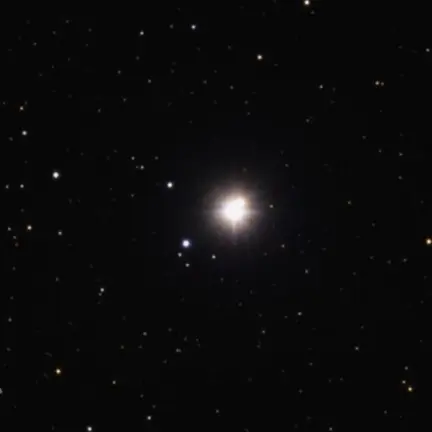
A near-twin of the Sun with a small orange partner — and a name nobody can trace back before 1950.
Look at Achird and you are seeing roughly what our own Sun would look like from out there. It is almost a copy of the Sun: just 3% heavier and 13% more luminous, with a very similar surface temperature. Both it and its partner contain only about half as much of the heavier elements as the Sun does.
Its companion is a smaller, cooler star with just over half the Sun’s mass and only 8% of its light. The two swing around each other in roughly 470 years on an oval orbit, closing to a little beyond Neptune’s distance from the Sun before drifting out to three times as far.
William Herschel discovered the pair in August 1779. Any planet here would have to stay close to home: one circling the brighter star could only keep a stable orbit within about 9.5 times Earth’s distance from the Sun.
Eta Cassiopeiae (Achird) is 19.3 light-years away: the light we see from it set off in 2007, around the time Pluto was reclassified as a dwarf planet.
Did you know?
- A name without a past. The name Achird first appears in the Skalnaté Pleso Atlas of the Heavens, published in 1950. No one knows where it came from, yet the IAU made it official in 2017.
- A planet in waiting?. Achird shows a repeating wobble every 868 days or so that could come from a planet at least 22 times Earth’s mass. It is unconfirmed, and might instead be a long-term activity cycle.
- The charioteer. In Chinese astronomy it belongs to Wang Liang, an asterism named after a famous charioteer of the Spring and Autumn period.
How big is it?
About as wide as the Sun — and 1.1 times as bright. Its main star is about 1.4 million km across. It has about the Sun’s mass. Its companion star is at least 80 times Earth’s distance from the Sun away — 2.7 times as far as Neptune is from the Sun.
A Sun-like star with a fainter, reddish companion. Its components (magnitudes 3.5 and 7.4; spectral types G1 V (yellow) and M (orange-red)) lie 13.6″ apart at PA 329° (predicted for 2027.0 from its 479-year orbit).
When and where to see it
It is best placed in the evening sky around November, when it crosses the meridian at about 10 pm local time (around midnight in October). It can be seen from everywhere north of 32°S and never sets north of 32°N.
At its highest it stands 82° up from 50°N, 67° up from 35°N, 32° up from the equator, below the horizon from 35°S.
Facts
- Type
- Double star
- Constellation
- Cassiopeia
- Designations
- Achird, η Cas, 24 Cas, 24 Cassiopeiae, STF 60, HIP 3821
- Magnitude
- 3.5
- Position
- RA 0h 49.1m, Dec +57° 49′ (J2000)
- Distance
- 19.3 light-years
- Discovered
- William Herschel, 1779
Open AstroPilot to see when Eta Cassiopeiae (Achird) is highest tonight from your location, how easy it is with your telescope or binoculars, and an eyepiece view.