Epsilon Lyrae (Double Double)
Epsilon Lyrae (Double Double) is a double star in the constellation Lyra, magnitude 5.2.
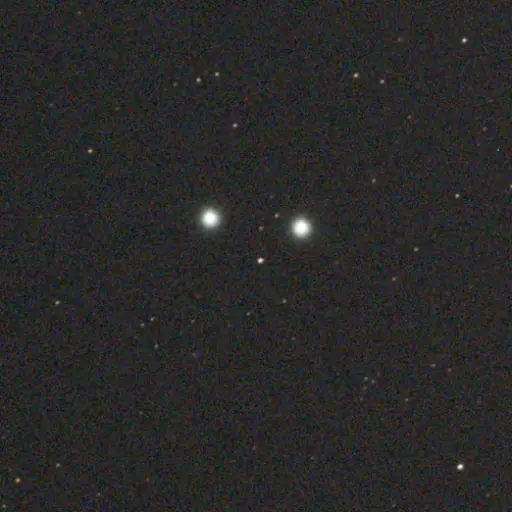
Two pairs of stars in a slow dance — named in 2026 after “the nostrils of the rat”.
Stand on a planet beside one half of the Double Double and the other half would blaze in your sky, about as bright as a quarter Moon, its two stars less than a degree apart.
Each pair is a binary in its own right. The stars of one take something like 1,200 years per orbit, the other perhaps half that, and the two pairs circle each other over hundreds of thousands of years. Since the first precise measurements in the 1980s, both have turned only a few degrees.
There are more members still. A fifth star, found in 1985 by speckle imaging, whips around one star of the southern pair. It has been seen only a few times, so no orbit can yet be worked out, but its rapid motion suggests it goes round in a few decades.
Epsilon Lyrae (Double Double) is 160 light-years away: the light we see from it set off around 1865, 13 years before Edison lit his first practical light bulb — the start of light pollution.
Did you know?
- The nostrils of the rat. On Pukapuka in the Cook Islands the system is Na ponga-ponga-iyu-o-te-kiole, “the nostrils of the rat”. In June 2026 the IAU gave the shortened form, Pongaponga, to the main star of the northern pair.
- A gentle pulse. In 2022 researchers using data from NASA’s TESS satellite found that the fainter star of the northern pair is a Gamma Doradus variable, pulsing with a main period of 0.415 days.
How big is it?
2.8 times as wide as the Sun — and 24 times as bright. Its main star is about 3.9 million km across. It has twice the Sun’s mass. Its companion star is at least 103 times Earth’s distance from the Sun away — 3.4 times as far as Neptune is from the Sun.
The famous "Double Double" near Vega. ε¹'s components (magnitudes 5.2 and 6.1; spectral types A4 V (white) and F1 V (yellow-white)) lie 2.1″ apart at PA 342° (measured 2025). ε¹ and ε² are 209.4″ apart (easy in binoculars), and ε² splits into stars of magnitude 5.3 and 5.4, 2.4″ apart.
When and where to see it
It is best placed in the evening sky around August, when it crosses the meridian at about 10 pm local time (around midnight in July). It can be seen from everywhere north of 50°S and never sets north of 50°N.
At its highest it stands 80° up from 50°N, 85° up from 35°N, 50° up from the equator, 15° up from 35°S.
Facts
- Type
- Double star
- Constellation
- Lyra
- Designations
- Double Double, Epsilon Lyrae, ε Lyr, ε¹ Lyr, Epsilon¹ Lyrae, ε² Lyr, Epsilon² Lyrae, 4 Lyr, 4 Lyrae, 5 Lyr, 5 Lyrae, STF 2382, STFA 37, STF 2383, HIP 91919
- Magnitude
- 5.2
- Position
- RA 18h 44.3m, Dec +39° 40′ (J2000)
- Distance
- 160 light-years
Open AstroPilot to see when Epsilon Lyrae (Double Double) is highest tonight from your location, how easy it is with your telescope or binoculars, and an eyepiece view.