Cor Caroli (α CVn)
Cor Caroli (α CVn) is a double star in the constellation Canes Venatici, magnitude 2.9.
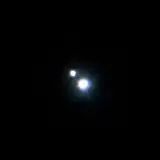
A star named for a king’s heart — and a magnetic oddball with an atmosphere full of rare metals.
“Charles’s Heart” — the name comes from the turbulent England of the 1600s. In 1660 Sir Charles Scarborough, physician to Charles II, claimed the star shone with unusual brightness on the night the king returned to England. Yet the first star map to show the name, Francis Lamb’s chart of 1673, labels it “the heart of Charles the martyred king” — meaning his father, Charles I, executed in 1649.
The star itself is just as unusual. Its brighter member has a magnetic field about 5,000 times as strong as Earth’s, and an atmosphere oddly rich in silicon, mercury and europium, as some elements sink under gravity while others are pushed up by the pressure of light. Its magnetism is thought to create enormous spots, so its brightness changes as it turns, every 5.47 days. It is the prototype of a whole class of variable stars.
Its fainter partner is an ordinary yellow-white star. The two take roughly 8,000 years to complete one orbit.
Cor Caroli (α CVn) is 100 light-years away: the light we see from it set off around 1925, around the time Edwin Hubble showed that other galaxies exist.
Did you know?
- Halley’s name?. Some books say Scarborough suggested the name to Edmond Halley. That story first appears in a report published in 1801 and seems to have no other support.
- Top of the Diamond. Cor Caroli marks the northern point of the Great Diamond, a large asterism also known as the Diamond of Virgo.
- The Imperial Guards. In Chinese astronomy it is the first star of Cháng Chén, the Imperial Guards — the source of another name, Chang Chen.
How big is it?
2.5 times as wide as the Sun — and 101 times as bright. Its main star is about 3.5 million km across. It has 3 times the Sun’s mass. Its companion star is at least 589 times Earth’s distance from the Sun away — 20 times as far as Neptune is from the Sun.
An easy, attractive pair in Canes Venatici for any small telescope. Its components (magnitudes 2.9 and 5.5) lie 19.2″ apart at PA 229° (measured 2023).
When and where to see it
It is best placed in the evening sky around May, when it crosses the meridian at about 10 pm local time (around midnight in April). It can be seen from everywhere north of 52°S and never sets north of 52°N.
At its highest it stands 78° up from 50°N, 87° up from 35°N, 52° up from the equator, 17° up from 35°S.
Facts
- Type
- Double star
- Constellation
- Canes Venatici
- Designations
- α CVn, Alpha Canum Venaticorum, α² CVn, Alpha² Canum Venaticorum, α¹ CVn, Alpha¹ Canum Venaticorum, 12 CVn, 12 Canum Venaticorum, STF 1692, HIP 63125
- Magnitude
- 2.9
- Position
- RA 12h 56.0m, Dec +38° 19′ (J2000)
- Distance
- 100 light-years
- Discovered
- Named Cor Caroli in 1660
Open AstroPilot to see when Cor Caroli (α CVn) is highest tonight from your location, how easy it is with your telescope or binoculars, and an eyepiece view.