Antares (α Sco)
Antares (α Sco) is a double star in the constellation Scorpius, magnitude 1.0.
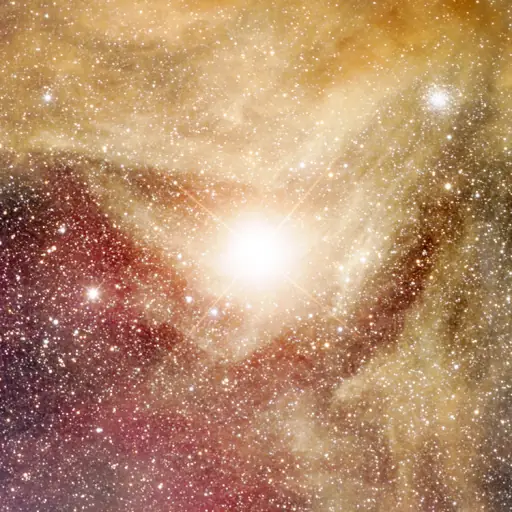
Mars’s red rival — a supergiant so vast it would swallow the planets out to the asteroid belt.
Put Antares where the Sun is and its surface would reach somewhere out in the asteroid belt, engulfing Mercury, Venus, Earth and Mars. It is a pulsating red supergiant, between 13 and 16 times the Sun’s mass, late in its life — a star that will one day explode as a supernova.
Its colour gave it its name. Antares comes from the Greek for “rival to Ares” — or, more bluntly, “not Ares” — because its reddish glow looks so like Mars. The name already appears in Ptolemy’s writings; Mesopotamian astronomers had called it the heart of the Scorpion.
A small, hot companion hides in its glare. Johann Tobias Bürg first reported it in 1819, during an occultation, but few believed him. James William Grant saw it from India in 1844, and Ormsby Mitchel found it again in 1846.
Antares (α Sco) is 550 light-years away: the light we see from it set off around 1475, around the time Columbus crossed the Atlantic.
Did you know?
- Remembered as the red man. Research published in 2018 showed that the Ngarrindjeri people of South Australia noticed Antares changing in brightness and wove it into their oral traditions as Waiyungari, the “red man”.
- Venus’s rare visit. Venus last passed directly in front of Antares on 17 September 525 BC. The next time will be on 17 November 2400.
- A breathing star. Early 20th-century astronomers saw its spectrum shifting and suspected an orbit. It turned out to be the star’s atmosphere pulsing; by 1928 they reckoned its size changes by about 20%.
- Lighting the clouds. Antares lights up part of the Rho Ophiuchi cloud complex in front of it. The glowing patch is sometimes called the Antares Nebula.
How big is it?
In the Sun’s place, it would swallow the orbits of Mercury, Venus, Earth and Mars. Its main star is 680 times as wide as the Sun — about 950 million km across. Light takes 53 minutes to cross it; it crosses the Sun in under five seconds. For all its size it holds only 13 Suns’ worth of matter: on average it is thinner than the air you breathe. It gives off as much light as 76,000 Suns. That is still heavy enough for it to end its life as a supernova. Its companion star is at least 455 times Earth’s distance from the Sun away — 15 times as far as Neptune is from the Sun.
The red supergiant heart of Scorpius; its greenish companion is a challenge close to the glare. Its components (magnitudes 1.0 and 5.4) lie 2.7″ apart at PA 277° (measured 2019).
When and where to see it
It is best placed in the evening sky around June, when it crosses the meridian at about 10 pm local time (around midnight in May). It can be seen from everywhere south of 64°N and never sets south of 64°S.
At its highest it stands 14° up from 50°N, 29° up from 35°N, 64° up from the equator, 81° up from 35°S.
Facts
- Type
- Double star
- Constellation
- Scorpius
- Designations
- α Sco, Alpha Scorpii, 21 Sco, 21 Scorpii, GNT 1, HIP 80763
- Magnitude
- 1.0
- Position
- RA 16h 29.4m, Dec −26° 26′ (J2000)
- Distance
- 550 light-years
- Discovered
- Johann Tobias Bürg, 1819, Companion first reported in 1819 but doubted; seen by James William Grant in 1844
Open AstroPilot to see when Antares (α Sco) is highest tonight from your location, how easy it is with your telescope or binoculars, and an eyepiece view.