Alpha Centauri (Rigil Kentaurus)
Alpha Centauri (Rigil Kentaurus) is a double star in the constellation Centaurus, magnitude 0.0.
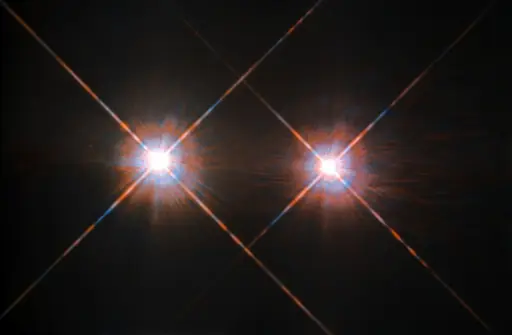
Our nearest stellar neighbours: two Sun-like stars and a little red dwarf with an Earth-sized planet.
Two suns much like our own circle each other every 79 years, swinging between roughly the distance of Saturn from the Sun and that of Pluto. Rigil Kentaurus is a little heavier and brighter than the Sun; Toliman a little smaller and cooler. Together they make the third-brightest star in the night sky, outshone only by Sirius and Canopus.
Far out from the pair drifts a third member, the faint red dwarf Proxima Centauri — the closest star of all to the Sun. Robert Innes found it in 1915 and named it from the Latin for “nearest”. It has at least two planets, one of them Earth-sized and in the zone where liquid water could exist, though it is probably not habitable.
In December 1689 Jean Richaud, watching a passing comet from Puducherry in India, noticed that the bright star was double. It was only the third binary star ever found.
Alpha Centauri (Rigil Kentaurus) is 4.4 light-years away: the light we see from it set off in 2022, around the time the James Webb Space Telescope was launched.
Did you know?
- A flaring neighbour. Proxima is a flare star that can brighten without warning. In August 2015 it flared to 8.3 times its normal brightness in blue light, the largest outburst on record.
- The two brothers. To the Boorong people of north-western Victoria, Alpha and Beta Centauri are two brothers who speared Tchingal, the Emu — the dark Coalsack Nebula.
- Lost from Alexandria. Ptolemy listed it in the 2nd century, when it could still be seen from Alexandria in Egypt. The slow wobble of Earth’s axis has since carried it out of view from there.
- A planet in waiting. Rigil Kentaurus may have a planet about as massive as Saturn in its habitable zone, though astronomers are not yet certain it is a planet.
How big is it?
1.2 times as wide as the Sun — and 1.5 times as bright. Its main star is about 1.7 million km across. It has 1.1 times the Sun’s mass. Its companion star is at least 13 times Earth’s distance from the Sun away — closer than Neptune is to the Sun.
The nearest star system to the Sun: two Sun-like stars in a mutual orbit. Its components (magnitudes 0.0 and 1.3; spectral types G2 V (yellow) and K1 V (orange)) lie 9.77″ apart at PA 14° (predicted for 2027.0 from its 79.8-year orbit).
When and where to see it
It is best placed in the evening sky around June, when it crosses the meridian at about 10 pm local time (around midnight in May). It can be seen from everywhere south of 29°N and never sets south of 29°S.
At its highest it stands below the horizon from 50°N, below the horizon from 35°N, 29° up from the equator, 64° up from 35°S.
Facts
- Type
- Double star
- Constellation
- Centaurus
- Designations
- Rigil Kentaurus, α Cen, α¹ Cen, Alpha¹ Centauri, RHD 1, HIP 71683
- Magnitude
- 0.0
- Position
- RA 14h 39.6m, Dec −60° 50′ (J2000)
- Distance
- 4.4 light-years
- Discovered
- Jean Richaud, 1689, Found to be double; the star itself has been known since antiquity
Open AstroPilot to see when Alpha Centauri (Rigil Kentaurus) is highest tonight from your location, how easy it is with your telescope or binoculars, and an eyepiece view.