Almach (γ And)
Almach (γ And) is a double star in the constellation Andromeda, magnitude 2.3.
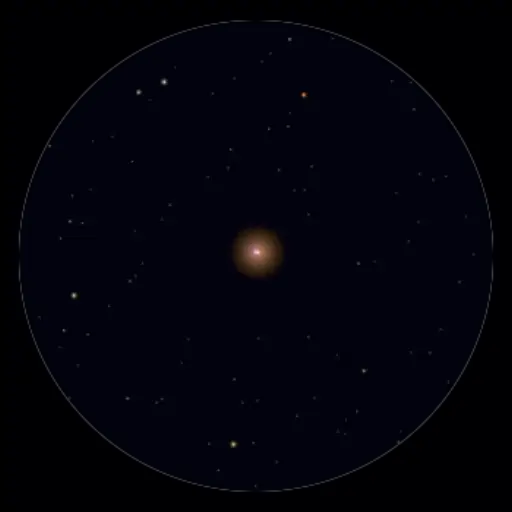
Named after a desert lynx — a bright giant whose faint companion kept splitting until it was three stars.
In 1778 Johann Tobias Mayer discovered that Almach is double: a bright giant with a much fainter partner. Then the partner kept splitting. In 1842 Wilhelm Struve found it was itself a close pair, and spectra taken in the late 1950s showed that one of those is a pair too. What looks like a single star to the eye is a family of four.
The innermost two are hot blue-white stars racing around each other every 2.67 days — and in 2026 observers found that they eclipse one another. That pair circles a third star every 64 years on a very elongated orbit, and the whole trio takes around 5,000 years to go round the giant.
The name comes from the Arabic al-‘anāq, the caracal, a desert lynx. Medieval astronomers writing in Arabic also called it the foot of the chained woman — Andromeda herself.
Almach (γ And) is 390 light-years away: the light we see from it set off around 1635, 25 years after Galileo first turned a telescope to the sky.
Did you know?
- The Babylonian Plough. In Babylonian star catalogues, Almach and the stars of Triangulum formed a constellation called the Plough. Astrologers considered the star “honourable and eminent”.
- Near the end of the giant road. The bright star is a massive giant that may be close to the end of its giant phase, though its surface chemistry lacks some of the signs astronomers would expect.
- The fifth ostrich. One medieval Arabic star catalogue listed it as “the fifth ostrich”, rendered in Latin translation as Quinta Struthionum.
How big is it?
In the Sun’s place, it would swallow the orbit of Mercury. Its main star is 99 times as wide as the Sun — about 140 million km across. Light takes 8 minutes to cross it; it crosses the Sun in under five seconds. For all its size it holds only 14 Suns’ worth of matter: on average it is thinner than the air you breathe. It gives off as much light as 2,990 Suns. That is still heavy enough for it to end its life as a supernova. Its companion star is at least 1,140 times Earth’s distance from the Sun away — 38 times as far as Neptune is from the Sun.
A showcase color-contrast double: a golden-orange primary with a blue companion. Its components (magnitudes 2.3 and 5.0) lie 9.5″ apart at PA 63° (measured 2024).
When and where to see it
It is best placed in the evening sky around November, when it crosses the meridian at about 10 pm local time (around midnight in October). It can be seen from everywhere north of 48°S and never sets north of 48°N.
At its highest it stands 82° up from 50°N, 83° up from 35°N, 48° up from the equator, 13° up from 35°S.
Facts
- Type
- Double star
- Constellation
- Andromeda
- Designations
- γ And, Gamma Andromedae, γ¹ And, Gamma¹ Andromedae, 57 And, 57 Andromedae, STF 205, HIP 9640
- Magnitude
- 2.3
- Position
- RA 2h 3.9m, Dec +42° 20′ (J2000)
- Distance
- 390 light-years
- Discovered
- Johann Tobias Mayer, 1778
Open AstroPilot to see when Almach (γ And) is highest tonight from your location, how easy it is with your telescope or binoculars, and an eyepiece view.