Algieba (γ Leo)
Algieba (γ Leo) is a double star in the constellation Leo, magnitude 2.4.
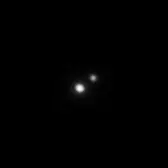
Two ageing giants in the Lion’s mane — and a planet at least ten times heavier than Jupiter.
Both stars of Algieba are giants that have left the prime of their lives behind. Around 2 billion years old, each has been through a sudden “helium flash” and now quietly burns helium in its core. The brighter shines about 250 times as brightly as the Sun, its partner about 63 times.
In 2009 astronomers announced a planet circling the brighter star every 429 days, only a little farther out than Earth is from the Sun. It is a gas giant at least ten times the mass of Jupiter — perhaps even heavy enough to be a brown dwarf, a failed star, rather than a true planet.
The name is a small mix-up. It comes from the Arabic al-Jabhah, “the forehead”, yet the star sits in the Lion’s mane — which suits its old Latin name, Juba.
Algieba (γ Leo) is 130 light-years away: the light we see from it set off around 1895, 7 years before the Wright brothers made the first powered flight.
Did you know?
- An orbit still unpinned. William Herschel found Algieba was double in 1792. Even with 190 years of measurements, the orbit is uncertain: a 2025 estimate gives about 553 years per lap.
- A typing error. In 1959 Algieba was mistakenly published as an eclipsing binary. The cause was a typographical slip: the paper meant a different star, Y Leonis.
- An unrelated neighbour. Just 5′ away on the sky lies AD Leonis, a flaring red dwarf. It has nothing to do with the pair and is far closer to us.
How big is it?
18,000 Suns could fit inside it. Its main star is 26 times as wide as the Sun — about 36 million km across. Light takes 2 minutes to cross it; it crosses the Sun in under five seconds. For all its size it holds only 1.7 Suns’ worth of matter: on average it is thinner than the air you breathe. It gives off as much light as 250 Suns. Its companion star is at least 191 times Earth’s distance from the Sun away — 6.4 times as far as Neptune is from the Sun.
A bright pair of golden giants in the Sickle of Leo. Its components (magnitudes 2.4 and 3.6; spectral types K1 III (orange) and G7 (yellow)) lie 4.8″ apart at PA 127° (measured 2024).
When and where to see it
It is best placed in the evening sky around March, when it crosses the meridian at about 10 pm local time (around midnight in February). It can be seen from everywhere north of 70°S and never sets north of 70°N.
At its highest it stands 60° up from 50°N, 75° up from 35°N, 70° up from the equator, 35° up from 35°S.
Facts
- Type
- Double star
- Constellation
- Leo
- Designations
- γ Leo, Gamma Leonis, γ¹ Leo, Gamma¹ Leonis, 41 Leo, 41 Leonis, STF 1424, HIP 50583
- Magnitude
- 2.4
- Position
- RA 10h 20.0m, Dec +19° 51′ (J2000)
- Distance
- 130 light-years
- Discovered
- William Herschel, 1792
Open AstroPilot to see when Algieba (γ Leo) is highest tonight from your location, how easy it is with your telescope or binoculars, and an eyepiece view.