Albireo (β Cyg)
Albireo (β Cyg) is a double star in the constellation Cygnus, magnitude 3.2.
A name born from a translator’s slip — and, millions of years from now, the brightest star in our sky.
Nobody is sure the two stars of Albireo belong together. If they do orbit each other, a single lap takes at least 100,000 years. Some astronomers think they are a chance alignment instead, the two stars drifting in slightly different directions — and not even the Hipparcos and Gaia space missions have settled the question.
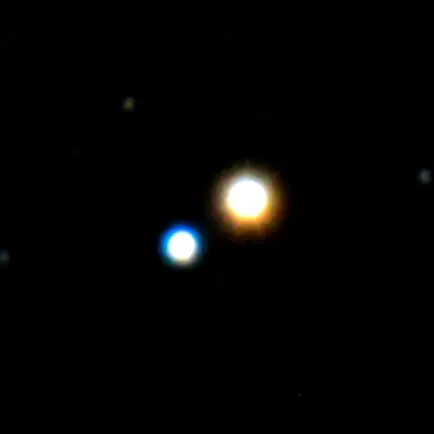
The colours tell you what they are. The brighter, orange star is a cool giant many times wider than the Sun. The blue one is far hotter, with a surface of about 13,200 kelvins, and spins at least 250 kilometres a second at its equator.
Even the name is a puzzle. The 19th-century scholar Christian Ludwig Ideler traced “Albireo” to a garbled phrase, ab ireo, in a medieval Latin translation of Ptolemy — later given an extra “l” as though it were Arabic. Medieval Arabic-speaking astronomers had their own name for it: “the hen’s beak”.
Albireo (β Cyg) is 360 light-years away: the light we see from it set off around 1665, 20 years before Isaac Newton published his laws of motion and gravity.
Did you know?
- Tomorrow’s brightest star. Albireo is heading our way. In about 3.87 million years it should become the brightest star in the night sky, peaking at around magnitude −0.5 some 4.6 million years from now.
- A heavyweight in hiding. In 2023 the Gaia team found that the orange star is being tugged far harder than its known companion can explain. That companion may be a tight pair of its own — or a compact, collapsed star.
- A new member in 2022. In 2022 astronomers found another small star circling the orange giant every 371 days. It has only about 8.5% of the Sun’s mass.
How big is it?
200,000 Suns could fit inside it. Its main star is 59 times as wide as the Sun — about 82 million km across. Light takes 5 minutes to cross it; it crosses the Sun in under five seconds. For all its size it holds only 5.2 Suns’ worth of matter: on average it is thinner than the air you breathe. It gives off as much light as 1,260 Suns. Its companion star is at least 3,790 times Earth’s distance from the Sun away — 126 times as far as Neptune is from the Sun.
A stunning gold-and-blue double marking the head of Cygnus, the Swan. Its components (magnitudes 3.2 and 5.1; spectral types K3 II (orange) and B9.5 (blue-white)) lie 34.3″ apart at PA 54° (measured 2025).
When and where to see it
It is best placed in the evening sky around August, when it crosses the meridian at about 10 pm local time (around midnight in July). It can be seen from everywhere north of 62°S and never sets north of 62°N.
At its highest it stands 68° up from 50°N, 83° up from 35°N, 62° up from the equator, 27° up from 35°S.
Facts
- Type
- Double star
- Constellation
- Cygnus
- Designations
- β Cyg, Beta Cygni, β¹ Cyg, Beta¹ Cygni, β² Cyg, Beta² Cygni, 6 Cyg, 6 Cygni, STFA 43, HIP 95947
- Magnitude
- 3.2
- Position
- RA 19h 30.7m, Dec +27° 58′ (J2000)
- Distance
- 360 light-years
- Discovered
- Known since antiquity
Open AstroPilot to see when Albireo (β Cyg) is highest tonight from your location, how easy it is with your telescope or binoculars, and an eyepiece view.