Acrux (α Cru)
Acrux (α Cru) is a double star in the constellation Crux, magnitude 1.3.
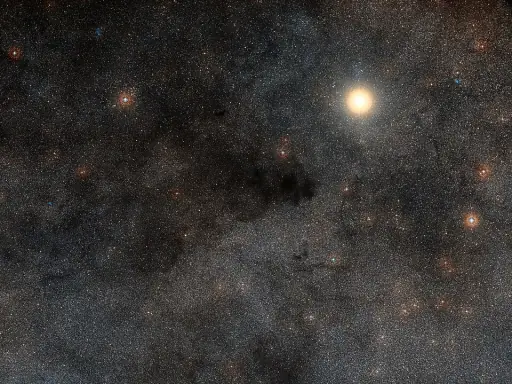
The brightest star of the Southern Cross, flown on five national flags — and home to seven suns.
Seven stars hide in the single point of light at the bottom of the Southern Cross. Its two brightest members are hot blue-white stars that take roughly 1,300 years to circle each other, and each of them is itself a close pair. A third, more distant member is a pair too, with a small red dwarf in tow. Together they make Acrux the 13th-brightest star in the night sky.
In 1685 a Jesuit priest noticed that it was double, making it only the second star system ever recognised as a binary. Its name is much more recent: the American astronomer Elijah Hinsdale Burritt coined “Acrux” in the 19th century by squeezing together its catalogue label, Alpha Crucis.
It lies so far south that it never rises north of latitude 27°. Yet because Earth’s axis slowly wobbles, the ancient Greeks and Romans could see it, counting it as part of the Centaur, and astronomers in ancient India named it Tri-shanku.
Acrux (α Cru) is 320 light-years away: the light we see from it set off around 1705, 19 years after Isaac Newton published his laws of motion and gravity.
Did you know?
- Five flags and a passport. Acrux appears on the flags of Australia, New Zealand, Samoa and Papua New Guinea. On Brazil’s flag it stands for the state of São Paulo, and it also features on the cover of the Brazilian passport.
- Destined to explode. The heaviest star, about 17 times the Sun’s mass, is expected to swell into a red supergiant like Betelgeuse or Antares and then explode as a supernova.
- The Star of Magellan. In Portuguese it is the Estrela de Magalhães, the “Star of Magellan”. Johann Bayer originally labelled it Zeta Centauri; Lacaille gave it the name Alpha Crucis in 1756.
How big is it?
314 Suns could fit inside it. Its main star is 6.8 times as wide as the Sun — about 9.5 million km across. It gives off as much light as 31,000 Suns. It has 17 times the Sun’s mass — heavy enough to end its life as a supernova. Its companion star is at least 343 times Earth’s distance from the Sun away — 11 times as far as Neptune is from the Sun.
The brightest star of the Southern Cross, splitting into two blue-white stars. Its components (magnitudes 1.3 and 1.6; spectral types B0.5 V (blue-white) and B1 V (blue-white)) lie 3.5″ apart at PA 111° (measured 2024).
When and where to see it
It is best placed in the evening sky around April, when it crosses the meridian at about 10 pm local time (around midnight in March). It can be seen from everywhere south of 27°N and never sets south of 27°S.
At its highest it stands below the horizon from 50°N, below the horizon from 35°N, 27° up from the equator, 62° up from 35°S.
Facts
- Type
- Double star
- Constellation
- Crux
- Designations
- α Cru, Alpha Crucis, α¹ Cru, Alpha¹ Crucis, DUN 252, HIP 60718
- Magnitude
- 1.3
- Position
- RA 12h 26.6m, Dec −63° 6′ (J2000)
- Distance
- 320 light-years
- Discovered
- 1685, Seen double by a Jesuit priest — the second binary ever recognised
Open AstroPilot to see when Acrux (α Cru) is highest tonight from your location, how easy it is with your telescope or binoculars, and an eyepiece view.