Acrab (β Sco)
Acrab (β Sco) is a double star in the constellation Scorpius, magnitude 2.6.
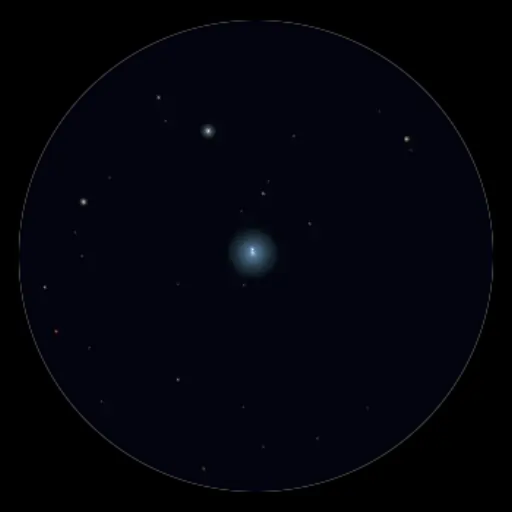
A star named after the whole Scorpion — with six suns hidden inside it, nested in pairs within pairs.
Pairs within pairs: what looks like one star to the eye, and two in a small telescope, is really a family of six. The two heaviest, 15 and 10 times the Sun’s mass, whirl around each other every 6.8 days. Together they circle a third star every 610 years, while the fainter half of the visible pair turns out to be a triple of its own.
These are young stars, only around 6 to 12 million years old — born long after the dinosaurs died out. They belong to the Scorpius–Centaurus association, a loose family of thousands of young stars spread across the southern sky.
The name Acrab comes from al-‘Aqrab, Arabic for “the Scorpion” — once the name of the whole constellation. Its other old name, Graffias, comes from a Greek word for a crab.
Acrab (β Sco) is 400 light-years away: the light we see from it set off around 1625, 17 years after Galileo first turned a telescope to the sky.
Did you know?
- Hidden by planets. Lying about a degree from the ecliptic, it can be covered by the Moon and, very rarely, by a planet. Venus passed in front of it on 9 December 1906, and Jupiter on 13 May 1971.
- On the flag of Brazil. Beta Scorpii is one of the stars on Brazil’s flag, where it stands for the state of Maranhão. A US Navy ship, USS Graffias, was also named after it.
- Strange chemistry. One of the fainter stars in the family has an odd surface: unusually rich in manganese and strontium, yet surprisingly poor in other metals.
How big is it?
250 Suns could fit inside it. Its main star is 6.3 times as wide as the Sun — about 8.8 million km across. It gives off as much light as 32,000 Suns. It has 15 times the Sun’s mass — heavy enough to end its life as a supernova. Its companion star is at least 1,680 times Earth’s distance from the Sun away — 56 times as far as Neptune is from the Sun.
A bright, easy pair of blue-white stars in Scorpius. Its components (magnitudes 2.6 and 4.9; spectral types B0.5 V (blue-white) and B2 V (blue-white)) lie 13.7″ apart at PA 19° (measured 2021).
When and where to see it
It is best placed in the evening sky around June, when it crosses the meridian at about 10 pm local time (around midnight in May). It can be seen from everywhere south of 70°N and never sets south of 70°S.
At its highest it stands 20° up from 50°N, 35° up from 35°N, 70° up from the equator, 75° up from 35°S.
Facts
- Type
- Double star
- Constellation
- Scorpius
- Designations
- β Sco, Beta Scorpii, β¹ Sco, Beta¹ Scorpii, β² Sco, Beta² Scorpii, 8 Sco, 8 Scorpii, H 3 7, HIP 78820
- Magnitude
- 2.6
- Position
- RA 16h 5.4m, Dec −19° 48′ (J2000)
- Distance
- 400 light-years
- Discovered
- Known since antiquity
Open AstroPilot to see when Acrab (β Sco) is highest tonight from your location, how easy it is with your telescope or binoculars, and an eyepiece view.