Leo I
Leo I is a galaxy in the constellation Leo, magnitude 10.4, 12′ × 8.5′ across.
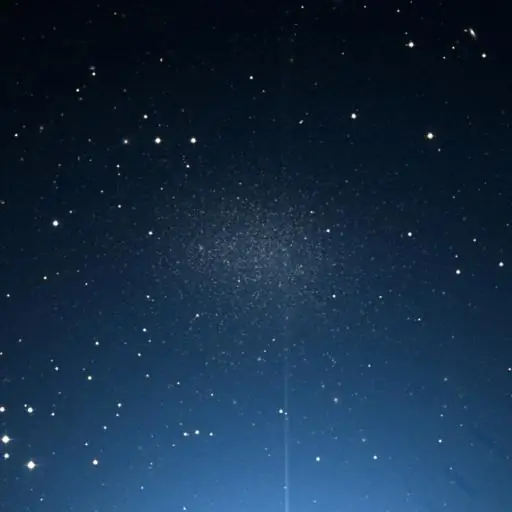
A dwarf galaxy hiding in the glare of Regulus, one of the most distant satellites of the Milky Way.
Albert Wilson found Leo I in 1950 on plates from the Palomar Observatory Sky Survey. It sits just 12 arcminutes from Regulus, the brightest star in Leo — hence its nickname, the Regulus Dwarf — and the star’s glare still makes it hard to study. This dwarf spheroidal galaxy is one of the farthest satellites of the Milky Way.
It is also thought to be the youngest of the Milky Way’s dwarf spheroidal satellites. Most of its stars formed between 6 and 2 billion years ago, and star formation dropped off suddenly about a billion years ago — around the time it last swung close to the Milky Way and probably lost its gas.
Leo I is 750,000 light-years away: the light we see from it set off about 750,000 years ago, when early humans were learning to use fire.
Did you know?
- A heavy heart?. One study suggested Leo I hides a black hole of about three million solar masses, comparable to the one at the Milky Way’s centre. Another found room for one of at most a few hundred thousand.
How big is it?
A dwarf beside the Milky Way. Light itself takes 2,560 years to cross it. Shrink it to the length of a football pitch and our whole Solar System would be thinner than a human hair.
A 10.4-magnitude elliptical galaxy (E) in Leo, about 12′ × 8.5′.
When and where to see it
It is best placed in the evening sky around March, when it crosses the meridian at about 10 pm local time (around midnight in February). It can be seen from everywhere north of 78°S and never sets north of 78°N.
At its highest it stands 52° up from 50°N, 67° up from 35°N, 78° up from the equator, 43° up from 35°S.
Facts
- Type
- Galaxy
- Constellation
- Leo
- Designations
- Leo I
- Magnitude
- 10.4
- Apparent size
- 12′ × 8.5′
- Position
- RA 10h 8.5m, Dec +12° 18′ (J2000)
- Distance
- 750,000 light-years
- Discovered
- Albert George Wilson, 1950
Open AstroPilot to see when Leo I is highest tonight from your location, how easy it is with your telescope or binoculars, and an eyepiece view.