Sextans B
Sextans B is a galaxy in the constellation Sextans, magnitude 11.5, 4.9′ × 3.1′ across.
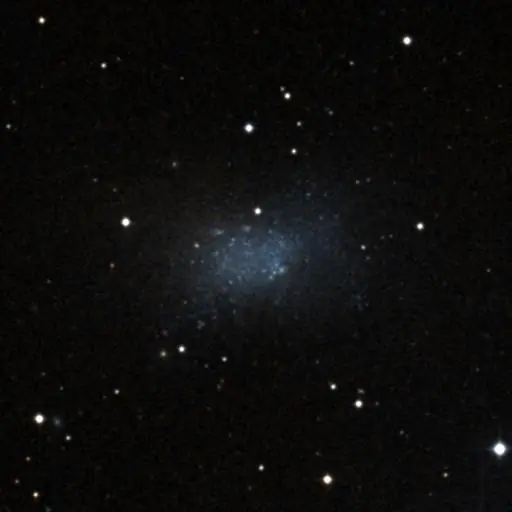
A dwarf galaxy on the edge of the Local Group — one of the smallest where planetary nebulae have been found.
Sextans B sits right on the border of our Local Group, and may lie just beyond it. It first appeared in print in 1954, listed as the “Wilson Dwarf”. This small irregular galaxy pairs up with its neighbour Sextans A and has made its stars in gentle spells, separated by shorter pauses when star formation stopped. Its stars and gas contain very little of the elements heavier than helium.
Sextans B is 4.5 million light-years away: the light we see from it set off about 4.5 million years ago, when our ancestors and the chimpanzees' were going their separate ways.
Did you know?
- Small but well stocked. Five planetary nebulae have been found in Sextans B, making it one of the smallest galaxies known to host them. It also has a massive globular cluster.
- A first nova. In November 2024 the ATLAS survey caught the first confirmed nova in this galaxy, now known as AT 2024aawe.
How big is it?
A dwarf beside the Milky Way. Light itself takes 6,410 years to cross it. Shrink it to the length of a football pitch and our whole Solar System would be about the size of a red blood cell.
An 11.5-magnitude barred irregular galaxy (IB) in Sextans, about 4.9′ × 3.1′.
When and where to see it
It is best placed in the evening sky around March, when it crosses the meridian at about 10 pm local time (around midnight in February). It can be seen from everywhere north of 85°S and never sets north of 85°N.
At its highest it stands 45° up from 50°N, 60° up from 35°N, 85° up from the equator, 50° up from 35°S.
Facts
- Type
- Galaxy
- Constellation
- Sextans
- Designations
- Sextans B
- Magnitude
- 11.5
- Apparent size
- 4.9′ × 3.1′
- Position
- RA 10h 0.0m, Dec +5° 20′ (J2000)
- Distance
- 4.5 million light-years
- Discovered
- Earliest known mention: a 1954 paper listing it as the “Wilson Dwarf”
Open AstroPilot to see when Sextans B is highest tonight from your location, how easy it is with your telescope or binoculars, and an eyepiece view.