Sextans Dwarf Spheroidal
Sextans Dwarf Spheroidal is a galaxy in the constellation Sextans, magnitude 10.4, 30′ × 12′ across.
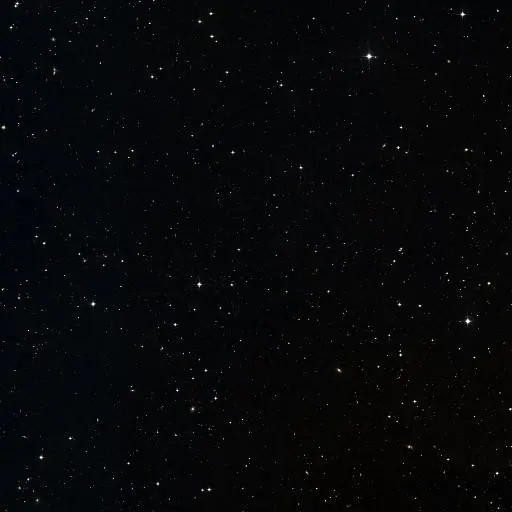
A faint, ghostly satellite of the Milky Way, found only in 1990 and full of old, primitive stars.
Even in 1990 the Milky Way still had companions waiting to be found. That year Mike Irwin, Peter Bunclark, Mick Bridgeland and Richard McMahon discovered the Sextans Dwarf, the eighth known satellite galaxy of our own. Like other dwarf spheroidals it is faint and diffuse, little more than a thin haze of stars. Its stars are old and poor in heavy elements — some of them strikingly so.
Sextans Dwarf Spheroidal is 290,000 light-years away: the light we see from it set off about 290,000 years ago, when the first Homo sapiens appeared in Africa.
How big is it?
A dwarf beside the Milky Way. Light itself takes 2,550 years to cross it. Shrink it to the length of a football pitch and our whole Solar System would be thinner than a human hair.
A 10.4-magnitude elliptical/lenticular galaxy (E-S0) in Sextans, about 30′ × 12′.
When and where to see it
It is best placed in the evening sky around March, when it crosses the meridian at about 10 pm local time (around midnight in February). It can be seen from everywhere south of 88°N and never sets south of 88°S.
At its highest it stands 38° up from 50°N, 53° up from 35°N, 88° up from the equator, 57° up from 35°S.
Facts
- Type
- Galaxy
- Constellation
- Sextans
- Designations
- Sextans Dwarf Spheroidal
- Magnitude
- 10.4
- Apparent size
- 30′ × 12′
- Position
- RA 10h 13.0m, Dec −1° 37′ (J2000)
- Distance
- 290,000 light-years
- Discovered
- Mike Irwin, Peter Bunclark, Mick Bridgeland and Richard McMahon, 1990
Open AstroPilot to see when Sextans Dwarf Spheroidal is highest tonight from your location, how easy it is with your telescope or binoculars, and an eyepiece view.