NGC 936
NGC 936 is a galaxy in the constellation Cetus, magnitude 10.2, 4.4′ × 3.2′ across.
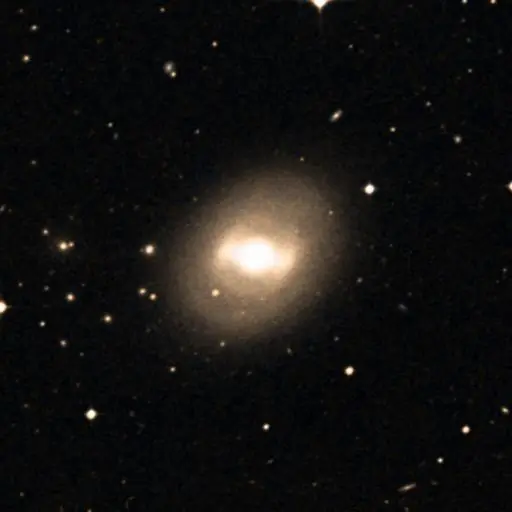
Darth Vader’s Galaxy: a bar, a ring and a bright core shaped like a TIE fighter.
A bright bar, a round nucleus and a ring of stars at the bar’s ends: to some eyes NGC 936 looks like a TIE fighter from Star Wars, so it has been called Darth Vader’s Galaxy or Darth Vader’s Starfighter. It is a barred lenticular galaxy. In 1986 John Kormendy measured the motions in its disc and found it stable, which is why it looks so smooth.
William Herschel discovered it on 6 January 1785 and, seeing a round glow, classed it as a planetary nebula.
NGC 936 is 75 million light-years away: the light we see from it set off about 75 million years ago, when dinosaurs still walked the Earth.
Did you know?
- Neighbours that never touch. The spiral NGC 941 appears close by, but the two galaxies are not interacting. Both belong to a small group linked with the larger group around M 77.
How big is it?
About as wide as our Milky Way. Light itself takes 97,000 years to cross it. Shrink it to the length of a football pitch and our whole Solar System would be smaller than a bacterium.
A 10.2-magnitude lenticular galaxy (S0-a) in Cetus, about 4.4′ × 3.2′.
When and where to see it
It is best placed in the evening sky around December, when it crosses the meridian at about 10 pm local time (around midnight in November). It can be seen from everywhere south of 89°N.
At its highest it stands 39° up from 50°N, 54° up from 35°N, 89° up from the equator, 56° up from 35°S.
Facts
- Type
- Galaxy
- Constellation
- Cetus
- Designations
- NGC 936
- Magnitude
- 10.2
- Apparent size
- 4.4′ × 3.2′
- Position
- RA 2h 27.6m, Dec −1° 9′ (J2000)
- Distance
- 75 million light-years
- Discovered
- William Herschel, 1785
Open AstroPilot to see when NGC 936 is highest tonight from your location, how easy it is with your telescope or binoculars, and an eyepiece view.