NGC 925
NGC 925 is a galaxy in the constellation Triangulum, magnitude 10.1, 11′ × 5.8′ across.
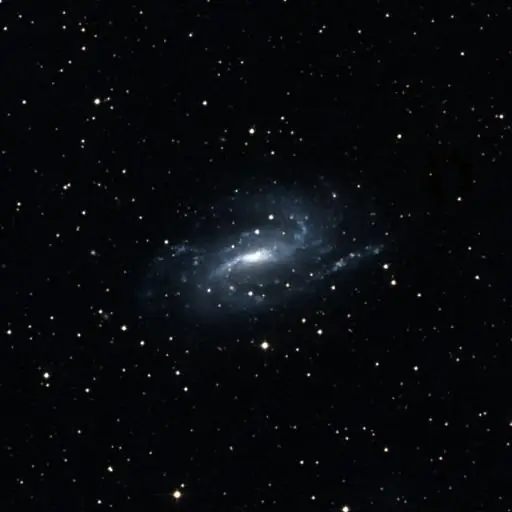
A lopsided spiral with an off-centre bar and a mysterious cloud of hydrogen on a leash.
Everything about NGC 925 is a little off-balance. Its bar sits off-centre, and its southern spiral arm is much stronger than the ragged northern one — traits typical of Magellanic spirals, named after the Large Magellanic Cloud. New stars are forming all along the bar.
Attached to the galaxy by a streamer is a cloud of hydrogen holding ten million times the mass of the Sun. It could be a small satellite galaxy, debris from an old encounter or untouched gas left over from the early universe; nobody yet knows. William Herschel discovered this barred spiral galaxy on 13 September 1784.
NGC 925 is 30 million light-years away: the light we see from it set off about 30 million years ago, when the Himalayas and the Alps were rising.
Did you know?
- A merger’s flash. No supernova has been seen in NGC 925 yet, but in 2023 the ATLAS survey caught a luminous red nova here — the kind of outburst thought to happen when two stars merge.
How big is it?
About as wide as our Milky Way. Light itself takes 94,000 years to cross it. Shrink it to the length of a football pitch and our whole Solar System would be smaller than a bacterium.
A 10.1-magnitude spiral galaxy (Scd) in Triangulum, about 11′ × 5.8′.
When and where to see it
It is best placed in the evening sky around December, when it crosses the meridian at about 10 pm local time (around midnight in November). It can be seen from everywhere north of 56°S and never sets north of 56°N.
At its highest it stands 74° up from 50°N, 89° up from 35°N, 56° up from the equator, 21° up from 35°S.
Facts
- Type
- Galaxy
- Constellation
- Triangulum
- Designations
- NGC 925
- Magnitude
- 10.1
- Apparent size
- 11′ × 5.8′
- Position
- RA 2h 27.3m, Dec +33° 35′ (J2000)
- Distance
- 30 million light-years
- Discovered
- William Herschel, 1784
Open AstroPilot to see when NGC 925 is highest tonight from your location, how easy it is with your telescope or binoculars, and an eyepiece view.