NGC 908
NGC 908 is a galaxy in the constellation Cetus, magnitude 10.3, 6.1′ × 2.8′ across.
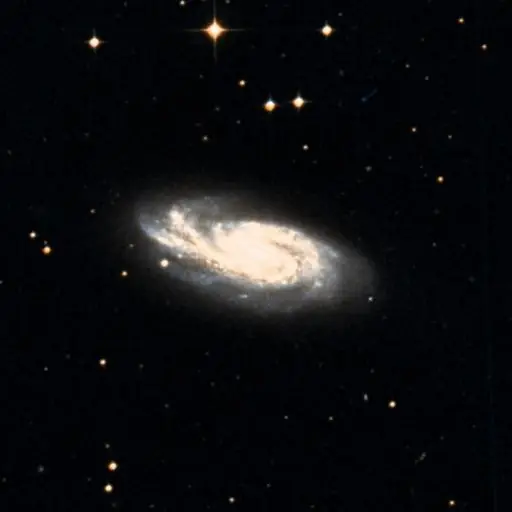
A spiral galaxy in a frenzy of star birth, shaken up by an encounter with a vanished partner.
Something stirred NGC 908 up. This spiral galaxy is forming stars at a furious pace — a starburst — and two of its three arms are oddly shaped, dotted with clusters of young stars. Both are signs of a close encounter with another galaxy, yet no culprit is anywhere to be seen.
William Herschel discovered it on 20 September 1786. It is the main galaxy of a small group with NGC 899, NGC 907 and IC 223.
NGC 908 is 55 million light-years away: the light we see from it set off about 55 million years ago, when mammals were taking over a world without dinosaurs.
Did you know?
- A comet hunter’s supernova. Robert McNaught, later famous for the Great Comet of 2007 that bears his name, discovered a supernova here in 1994. Another, SN 2006ce, was found by amateur Berto Monard in 2006.
How big is it?
About as wide as our Milky Way. Light itself takes 98,000 years to cross it. Shrink it to the length of a football pitch and our whole Solar System would be smaller than a bacterium.
A 10.3-magnitude weakly barred spiral galaxy (SABc) in Cetus, about 6.1′ × 2.8′.
When and where to see it
It is best placed in the evening sky around November, when it crosses the meridian at about 10 pm local time (around midnight in November). It can be seen from everywhere south of 69°N and never sets south of 69°S.
At its highest it stands 19° up from 50°N, 34° up from 35°N, 69° up from the equator, 76° up from 35°S.
Facts
- Type
- Galaxy
- Constellation
- Cetus
- Designations
- NGC 908
- Magnitude
- 10.3
- Apparent size
- 6.1′ × 2.8′
- Position
- RA 2h 23.1m, Dec −21° 14′ (J2000)
- Distance
- 55 million light-years
- Discovered
- William Herschel, 1786
Open AstroPilot to see when NGC 908 is highest tonight from your location, how easy it is with your telescope or binoculars, and an eyepiece view.