Silver Sliver Galaxy (NGC 891)
Silver Sliver Galaxy (NGC 891) is a galaxy in the constellation Andromeda, magnitude 10.0, 13′ × 3.0′ across.
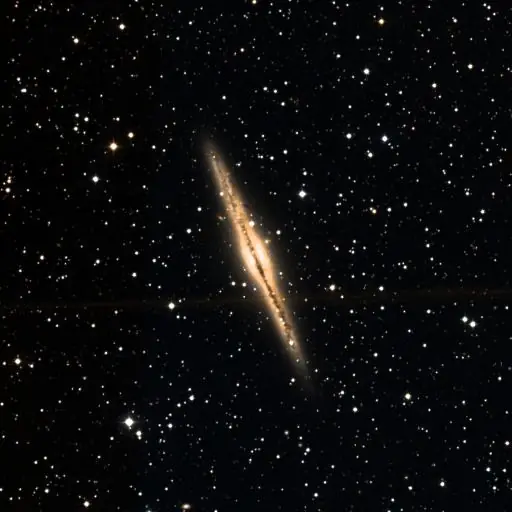
Our own Milky Way’s look-alike, seen edge-on — and a galaxy that found its way into songs and sci-fi credits.
If you could travel far out and look back at the Milky Way edge-on, it might look much like NGC 891. The two galaxies are similar in brightness and size, and some astronomers have noted how much our galaxy, seen from the Southern Hemisphere, resembles it. Like the Milky Way, it probably has a central bar.
Up close it is less tidy. Filaments of dust rise from its disc into the halo, perhaps flung out by exploding stars or pushed by starlight. Faint streams of stars loop around it — the remains of a smaller galaxy being torn apart and absorbed. William Herschel discovered this edge-on spiral on 6 October 1784.
Silver Sliver Galaxy (NGC 891) is 32 million light-years away: the light we see from it set off about 32 million years ago, when the Himalayas and the Alps were rising.
Did you know?
- The Outer Limits Galaxy. NGC 891 appeared in the end credits of the TV series The Outer Limits, which is why it is sometimes called the Outer Limits Galaxy.
- Music of the sliver. John Carpenter’s 1974 film Dark Star features a piece called “When Twilight Falls on NGC 891”, and Edgar Froese’s album Aqua, from the same year, has a track named after it.
- First light. NGC 891 was chosen as the first-light image of the Large Binocular Telescope in 2005, and again for the Lowell Discovery Telescope’s Large Monolithic Imager in 2012.
How big is it?
1.2 times as wide as our Milky Way. Light itself takes 120,000 years to cross it. Shrink it to the length of a football pitch and our whole Solar System would be smaller than a bacterium.
A classic edge-on spiral in Andromeda: a thin silver sliver, split by a dark dust lane in larger telescopes under dark skies.
When and where to see it
It is best placed in the evening sky around November, when it crosses the meridian at about 10 pm local time (around midnight in October). It can be seen from everywhere north of 48°S and never sets north of 48°N.
At its highest it stands 82° up from 50°N, 83° up from 35°N, 48° up from the equator, 13° up from 35°S.
Facts
- Type
- Galaxy
- Constellation
- Andromeda
- Designations
- NGC 891, C 23
- Magnitude
- 10.0
- Apparent size
- 13′ × 3.0′
- Position
- RA 2h 22.6m, Dec +42° 21′ (J2000)
- Distance
- 32 million light-years
- Discovered
- William Herschel, 1784
Open AstroPilot to see when Silver Sliver Galaxy (NGC 891) is highest tonight from your location, how easy it is with your telescope or binoculars, and an eyepiece view.