h Persei Cluster (NGC 869)
h Persei Cluster (NGC 869) is an open cluster in the constellation Perseus, magnitude 3.7, 18′ across.
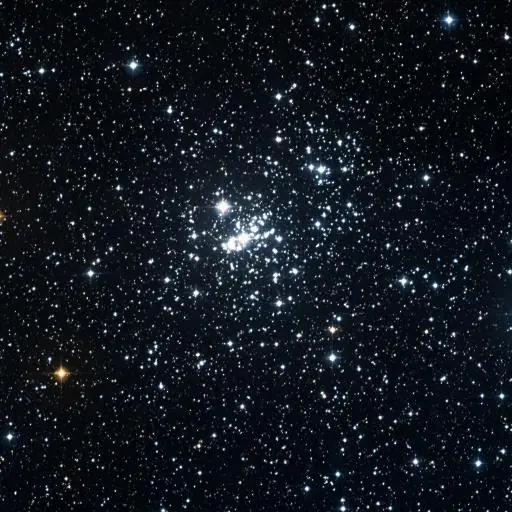
The western half of the Double Cluster, known since Hipparchus — and named by a small mystery.
More than two thousand years ago the Greek astronomer Hipparchus recorded a hazy patch between Perseus and Cassiopeia. A telescope splits it into two rich clusters side by side, and NGC 869 is the western one. Each is an open cluster of young, mostly blue-white stars.
Its name, h Persei, hides a puzzle. It is a Bayer letter, from Johann Bayer’s star atlas of 1603, and nobody is quite sure what he meant by it. Some argue that Bayer never saw the patch as two, and that his χ meant the whole Double Cluster and h a nearby star. Yet his chart of Cassiopeia does show the clusters as hazy patches.
h Persei Cluster (NGC 869) is 7,400 light-years away: the light we see from it set off around 5380 BC, around the time the first towns were growing in the Fertile Crescent.
How big is it?
Born about 15 million years ago, when great apes were spreading through Africa and Europe. Light itself takes 39 years to cross it. Gaia has picked out 403 stars moving together through space as its members. That’s 9.1 times the distance from the Sun to the nearest star. Shrink our Solar System — the Sun and all eight planets — to the size of a coin, and the h Persei Cluster would be 978 m across (9 football pitches end to end); the nearest star would be a football pitch away, and the Milky Way 2,520 km across.
h Persei, the western half of the Double Cluster (C14): a rich, bright open cluster that shares a low-power field with NGC 884.
When and where to see it
It is best placed in the evening sky around November, when it crosses the meridian at about 10 pm local time (around midnight in October). It can be seen from everywhere north of 33°S and never sets north of 33°N.
At its highest it stands 83° up from 50°N, 68° up from 35°N, 33° up from the equator, below the horizon from 35°S.
Facts
- Type
- Open cluster
- Constellation
- Perseus
- Designations
- NGC 869, Mel 13, Cr 24, Melotte 13, Collinder 24
- Magnitude
- 3.7
- Apparent size
- 18′
- Position
- RA 2h 19.0m, Dec +57° 7′ (J2000)
- Distance
- 7,400 light-years
- Discovered
- Hipparchus, Known since antiquity
Open AstroPilot to see when h Persei Cluster (NGC 869) is highest tonight from your location, how easy it is with your telescope or binoculars, and an eyepiece view.