NGC 7814 (C 43)
NGC 7814 (C 43) is a galaxy in the constellation Pegasus, magnitude 10.6, 4.4′ × 1.9′ across.
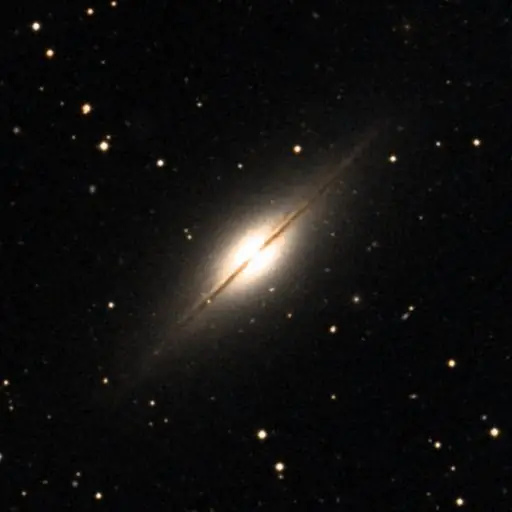
A side-on galaxy that works as a filter: light from distant galaxies behind it reveals the dust in its halo.
Behind NGC 7814 lies a crowd. Photographs of this edge-on spiral show the sky around it packed with faint, remote galaxies, much like the famous Hubble Deep Field.
Astronomers have put that backdrop to work. Light from the distant galaxies must pass through NGC 7814’s halo on its way to us, and it arrives redder than it set out, because dust scatters blue light more than red. Measuring the change reveals how much gas and dust the halo holds.
Seen exactly side-on, it is also one of the few bright galaxies whose disc shows a modest warp and twist in visible light. William Herschel discovered it in 1784.
NGC 7814 (C 43) is 47 million light-years away: the light we see from it set off about 47 million years ago, when mammals were taking over a world without dinosaurs.
Did you know?
- Found by a machine. Its one known supernova, SN 2021rhu — the explosion of a white dwarf — was flagged in July 2021 by ALeRCE, a system that uses machine learning to sort the night sky’s changes.
- Low numbers. It is UGC 8 and PGC 218. Both catalogues run in order around the sky, and this galaxy sits just past their starting line at zero hours of right ascension.
How big is it?
60% of the Milky Way’s width. Light itself takes 60,000 years to cross it. Shrink it to the length of a football pitch and our whole Solar System would be smaller than a bacterium.
An edge-on spiral in Pegasus with a large bulge and a thin dust lane, like a smaller version of the Sombrero Galaxy (M104).
When and where to see it
It is best placed in the evening sky around October, when it crosses the meridian at about 10 pm local time (around midnight in September). It can be seen from everywhere north of 74°S and never sets north of 74°N.
At its highest it stands 56° up from 50°N, 71° up from 35°N, 74° up from the equator, 39° up from 35°S.
Facts
- Type
- Galaxy
- Constellation
- Pegasus
- Designations
- C 43
- Magnitude
- 10.6
- Apparent size
- 4.4′ × 1.9′
- Position
- RA 0h 3.2m, Dec +16° 9′ (J2000)
- Distance
- 47 million light-years
- Discovered
- William Herschel, 1784
Open AstroPilot to see when NGC 7814 (C 43) is highest tonight from your location, how easy it is with your telescope or binoculars, and an eyepiece view.