Caroline's Rose (NGC 7789)
Caroline's Rose (NGC 7789) is an open cluster in the constellation Cassiopeia, magnitude 6.7, 14′ across.
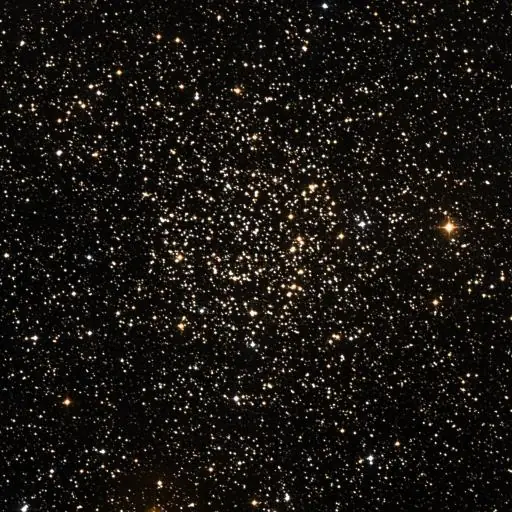
Caroline Herschel’s rose: a rich, billion-year-old cluster whose loops of stars look like petals.
Caroline Herschel spent many nights sweeping the sky for comets and nebulae with a small telescope her brother William built for her. In 1783 she came upon this rich cloud of faint stars in Cassiopeia, and William entered it in his catalogue as H VI.30. It now bears her name: to many observers its loops of stars and dark lanes swirl like the petals of a rose seen from above.
At 1.4 to 1.7 billion years old, NGC 7789 is middle-aged for an open cluster. It has a prominent crowd of red giants and an unusually large number of blue stragglers — stars that look younger than their siblings, probably rejuvenated by a companion.
Caroline's Rose (NGC 7789) is 6,400 light-years away: the light we see from it set off around 4380 BC, 1,130 years after the first towns were growing in the Fertile Crescent.
Did you know?
- A lithium mystery. Two of its red giants are unusually rich in lithium, an element such stars normally destroy. Mixing deep inside them, or a past encounter with a companion star, may explain it.
How big is it?
Born about 1.5 billion years ago, when there were no animals on Earth at all. Light itself takes 27 years to cross it. Gaia has picked out 4,125 stars moving together through space as its members. That’s 6.3 times the distance from the Sun to the nearest star. Shrink our Solar System — the Sun and all eight planets — to the size of a coin, and Caroline's Rose would be 677 m across (6 football pitches end to end); the nearest star would be a football pitch away, and the Milky Way 2,520 km across.
A 6.7-magnitude open cluster in Cassiopeia, about 14′ across.
When and where to see it
It is best placed in the evening sky around October, when it crosses the meridian at about 10 pm local time (around midnight in September). It can be seen from everywhere north of 33°S and never sets north of 33°N.
At its highest it stands 83° up from 50°N, 68° up from 35°N, 33° up from the equator, below the horizon from 35°S.
Facts
- Type
- Open cluster
- Constellation
- Cassiopeia
- Designations
- NGC 7789
- Magnitude
- 6.7
- Apparent size
- 14′
- Position
- RA 23h 57.4m, Dec +56° 42′ (J2000)
- Distance
- 6,400 light-years
- Discovered
- Caroline Herschel, 1783
Open AstroPilot to see when Caroline's Rose (NGC 7789) is highest tonight from your location, how easy it is with your telescope or binoculars, and an eyepiece view.