NGC 772
NGC 772 is a galaxy in the constellation Aries, magnitude 10.3, 4.6′ × 2.5′ across.
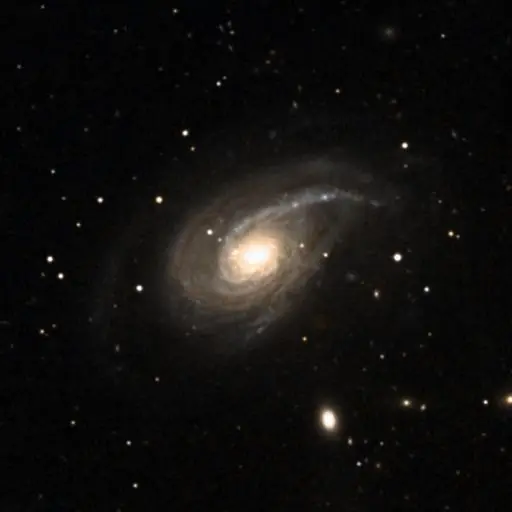
The Fiddlehead Galaxy: one giant arm curls out like a fern frond, pulled by its small companions.
One arm of NGC 772 is far longer and stronger than the others, curling outwards like the tip of an unfurling fern — hence its nickname, the Fiddlehead Galaxy. The likely cause is its satellite galaxies, including the small elliptical NGC 770, whose gravity tugs at the big spiral.
It is a large spiral galaxy. Halton Arp included it in his Atlas of Peculiar Galaxies as Arp 78. William Herschel discovered it on 29 November 1785.
NGC 772 is 120 million light-years away: the light we see from it set off about 120 million years ago, when dinosaurs still walked the Earth.
Did you know?
- Two supernovae at once. In 2003 two supernovae shone in NGC 772 at the same time: SN 2003hl, found in August, and SN 2003iq, discovered seven weeks later by Jean-Marie Llapasset.
How big is it?
1.6 times as wide as our Milky Way. Light itself takes 160,000 years to cross it. Shrink it to the length of a football pitch and our whole Solar System would be smaller than a bacterium.
A 10.3-magnitude spiral galaxy (Sb) in Aries, about 4.6′ × 2.5′.
When and where to see it
It is best placed in the evening sky around November, when it crosses the meridian at about 10 pm local time (around midnight in October). It can be seen from everywhere north of 71°S and never sets north of 71°N.
At its highest it stands 59° up from 50°N, 74° up from 35°N, 71° up from the equator, 36° up from 35°S.
Facts
- Type
- Galaxy
- Constellation
- Aries
- Designations
- NGC 772
- Magnitude
- 10.3
- Apparent size
- 4.6′ × 2.5′
- Position
- RA 1h 59.3m, Dec +19° 0′ (J2000)
- Distance
- 120 million light-years
- Discovered
- William Herschel, 1785
Open AstroPilot to see when NGC 772 is highest tonight from your location, how easy it is with your telescope or binoculars, and an eyepiece view.