Blue Snowball (NGC 7662)
Blue Snowball (NGC 7662) is a planetary nebula in the constellation Andromeda, magnitude 8.3, 32″ × 28″ across.
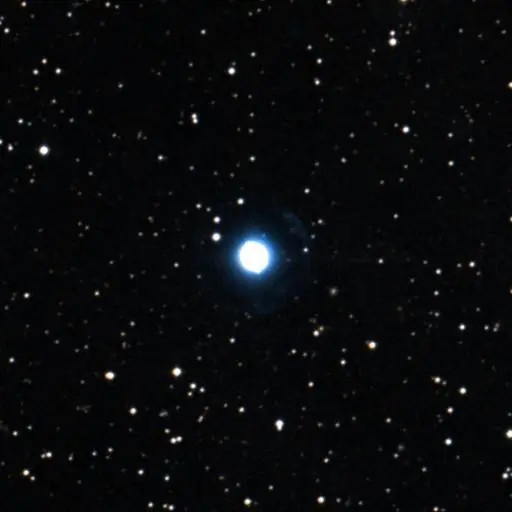
A snowball of glowing gas around a star of 100,000 degrees, blown out over the last 3,000 years.
Some 3,000 years ago, a dying star in Andromeda began throwing off its outer layers. Today they form the Blue Snowball: a planetary nebula built of a bright inner shell, a fainter outer one and a faint round halo enclosing both, threaded with knots and a jet-like streak.
At the centre sits what is left of the star: a hot subdwarf with a surface of around 100,000 degrees. It holds only about 60 per cent of the Sun’s mass, yet shines more than 5,000 times as brightly. Its wind still blows, and where it slams into gas shed earlier, the nebula glows in X-rays.
William Herschel discovered it on 6 October 1784. A century later the New General Catalogue described it with unusual enthusiasm as a “magnificent planetary or annular nebula”.
Blue Snowball (NGC 7662) is 5,700 light-years away: the light we see from it set off around 3680 BC, 470 years before writing was invented in Mesopotamia.
Did you know?
- Why it looks blue. Much of its blue-green colour comes from oxygen atoms that have lost two electrons, glowing as the central star’s ultraviolet light strikes them.
- Shaped like rugby balls. Its two shells are stretched spheroids — rugby-ball shapes — tilted to our line of sight, with the inner shell more elongated than the outer.
How big is it?
924 Solar Systems side by side. Light itself takes 11 months to cross it. Shrink our Solar System — the Sun and all eight planets — to the size of a coin, and Blue Snowball would be 22.2 m across (about the length of a tennis court); the nearest star would be a football pitch away, and the Milky Way 2,520 km across.
A bright planetary nebula that looks like a small blue-green disc; high magnification shows a brighter ring inside it.
When and where to see it
It is best placed in the evening sky around October, when it crosses the meridian at about 10 pm local time (around midnight in September). It can be seen from everywhere north of 47°S and never sets north of 47°N.
At its highest it stands 83° up from 50°N, 82° up from 35°N, 47° up from the equator, 12° up from 35°S.
Facts
- Type
- Planetary nebula
- Constellation
- Andromeda
- Designations
- NGC 7662, C 22, Copeland's Blue Snowball
- Magnitude
- 8.3
- Apparent size
- 32″ × 28″
- Position
- RA 23h 25.9m, Dec +42° 32′ (J2000)
- Distance
- 5,700 light-years
- Discovered
- William Herschel, 1784
Open AstroPilot to see when Blue Snowball (NGC 7662) is highest tonight from your location, how easy it is with your telescope or binoculars, and an eyepiece view.