Bubble Nebula (NGC 7635)
Bubble Nebula (NGC 7635) is an emission nebula in the constellation Cassiopeia, magnitude 11.0 (blue), 15′ × 8.0′ across.
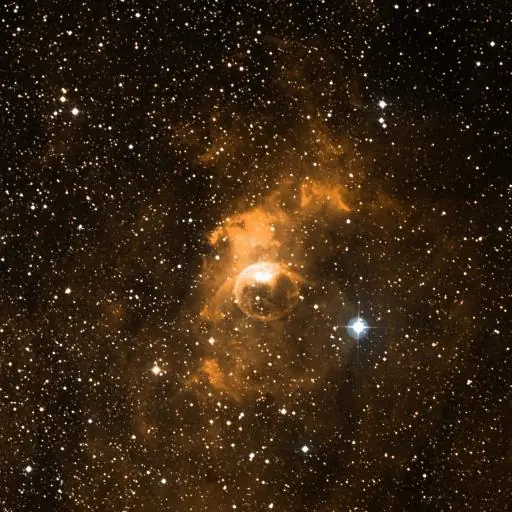
A single star, some 44 times the Sun’s mass, blowing a bubble of glowing gas into space.
A single star is inflating this bubble. BD+60°2522 is young, hot and enormous — around 44 times the mass of the Sun — and it drives a fierce wind of particles out into space. Where that wind meets the surrounding gas, it sweeps up a thin, glowing shell: the Bubble Nebula.
The bubble cannot grow freely. Nearby lies a giant molecular cloud, a dense reservoir of cold gas that holds back the expansion — and the star’s ultraviolet light makes that cloud glow too, turning it into part of the same emission nebula.
William Herschel discovered it in November 1787. In 2016 the Hubble Space Telescope marked 26 years in orbit with a detailed portrait of it.
Bubble Nebula (NGC 7635) is 9,100 light-years away: the light we see from it set off around 7080 BC, 1,570 years before the first towns were growing in the Fertile Crescent.
Did you know?
- Living fast. Stars as massive as BD+60°2522 burn through their fuel in only a few million years — a blink compared with the Sun’s lifetime of around ten billion.
- Sharpless 162. It is also number 162 in Stewart Sharpless’s 1959 catalogue of glowing hydrogen clouds, compiled from the photographs of the Palomar Sky Survey.
How big is it?
9.4 times the distance from the Sun to the nearest star. Light itself takes 40 years to cross it. Shrink our Solar System — the Sun and all eight planets — to the size of a coin, and the Bubble Nebula would be 1 km across (a 10-minute walk); the nearest star would be a football pitch away, and the Milky Way 2,520 km across.
A bubble of gas blown by the wind of a hot, massive star. The faint shell needs dark skies and a UHC or OIII filter; M52 lies 35′ away.
When and where to see it
It is best placed in the evening sky around October, when it crosses the meridian at about 10 pm local time (around midnight in September). It can be seen from everywhere north of 29°S and never sets north of 29°N.
At its highest it stands 79° up from 50°N, 64° up from 35°N, 29° up from the equator, below the horizon from 35°S.
Facts
- Type
- Emission nebula
- Constellation
- Cassiopeia
- Designations
- NGC 7635, C 11
- Magnitude
- 11.0 (blue)
- Apparent size
- 15′ × 8.0′
- Position
- RA 23h 20.8m, Dec +61° 13′ (J2000)
- Distance
- 9,100 light-years
- Discovered
- William Herschel, 1787
Open AstroPilot to see when Bubble Nebula (NGC 7635) is highest tonight from your location, how easy it is with your telescope or binoculars, and an eyepiece view.