NGC 752 (C 28)
NGC 752 (C 28) is an open cluster in the constellation Andromeda, magnitude 5.7, 1.3° across.
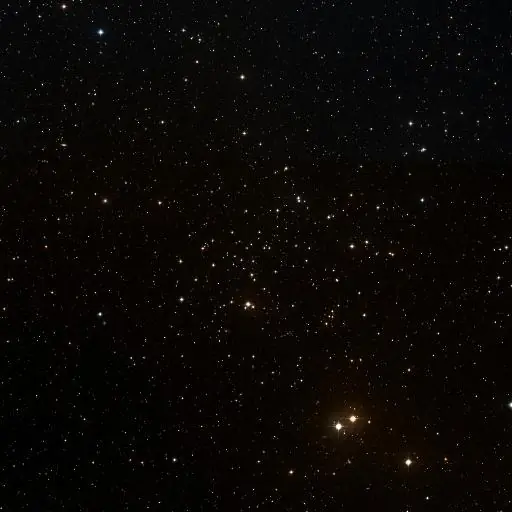
An elderly star cluster, 1.34 billion years old, perhaps glimpsed by Hodierna and found again by Caroline Herschel.
Open clusters rarely live long, but NGC 752 has held together for about 1.34 billion years. Time has thinned out its brightest stars: the heaviest have already evolved away, leaving mostly modest stars still burning hydrogen, along with red giants. Some 302 stars are now counted as members of this open cluster.
Caroline Herschel discovered it in 1783, and her brother William catalogued it in 1786. But the Sicilian astronomer Giovanni Battista Hodierna may have described it before 1654, more than a century earlier.
NGC 752 (C 28) is 1,400 light-years away: the light we see from it set off around AD 630, 90 years after the Hagia Sophia was completed in Constantinople.
Did you know?
- A straggler. NGC 752 has a blue straggler — a star that looks too hot and young for such an old cluster, probably formed when two stars merged.
- Stars that eclipse. The cluster includes DS Andromedae, a pair of stars that take turns passing in front of each other, dimming the light we receive.
How big is it?
Born about 1.2 billion years ago, when there were no animals on Earth at all. Light itself takes 31 years to cross it. Gaia has picked out 442 stars moving together through space as its members. That’s 7.2 times the distance from the Sun to the nearest star. Shrink our Solar System — the Sun and all eight planets — to the size of a coin, and NGC 752 would be 771 m across (7 football pitches end to end); the nearest star would be a football pitch away, and the Milky Way 2,520 km across.
A large, scattered open cluster in Andromeda, older than most at over a billion years; best in binoculars.
When and where to see it
It is best placed in the evening sky around November, when it crosses the meridian at about 10 pm local time (around midnight in October). It can be seen from everywhere north of 52°S and never sets north of 52°N.
At its highest it stands 78° up from 50°N, 87° up from 35°N, 52° up from the equator, 17° up from 35°S.
Facts
- Type
- Open cluster
- Constellation
- Andromeda
- Designations
- C 28, Mel 12, Cr 23, Melotte 12, Collinder 23
- Magnitude
- 5.7
- Apparent size
- 1.3°
- Position
- RA 1h 57.6m, Dec +37° 50′ (J2000)
- Distance
- 1,400 light-years
- Discovered
- Caroline Herschel, 1783, Possibly described by Hodierna before 1654
Open AstroPilot to see when NGC 752 (C 28) is highest tonight from your location, how easy it is with your telescope or binoculars, and an eyepiece view.