NGC 7510
NGC 7510 is an open cluster in the constellation Cepheus, magnitude 7.9, 3.9′ across.
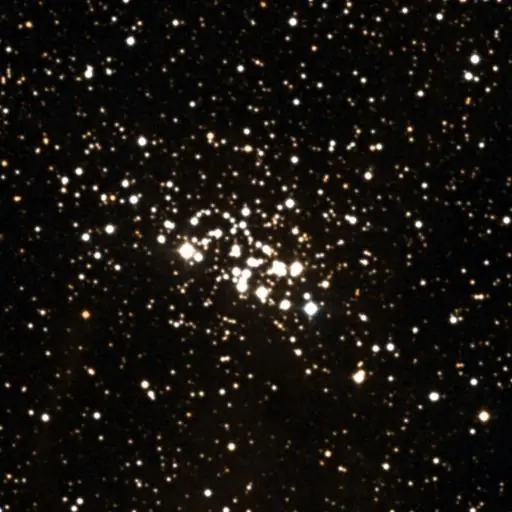
A young cluster in Cepheus, about ten million years old, lying in the next spiral arm out from ours.
Around ten million years old, NGC 7510 is a youngster among star clusters: its stars began to shine long after the dinosaurs had died out. It lies in the Perseus Arm, the next spiral arm of the Milky Way out from our own, and its brightest member is a hot, blue B-type giant. Interstellar dust between us and the cluster dims and reddens its light — the effect astronomers call extinction — so it looks fainter than it really is.
NGC 7510 is 9,700 light-years away: the light we see from it set off around 7680 BC, 1,830 years after the stone pillars of Göbekli Tepe, the oldest known temple, were raised.
How big is it?
Born about 19 million years ago, when great apes were spreading through Africa and Europe. Light itself takes 11 years to cross it. Gaia has picked out 588 stars moving together through space as its members. That’s 2.6 times the distance from the Sun to the nearest star. Shrink our Solar System — the Sun and all eight planets — to the size of a coin, and NGC 7510 would be 278 m across (3 football pitches end to end); the nearest star would be a football pitch away, and the Milky Way 2,520 km across.
A 7.9-magnitude open cluster in Cepheus, about 3.9′ across.
When and where to see it
It is best placed in the evening sky around October, when it crosses the meridian at about 10 pm local time (around midnight in September). It can be seen from everywhere north of 29°S and never sets north of 29°N.
At its highest it stands 79° up from 50°N, 64° up from 35°N, 29° up from the equator, below the horizon from 35°S.
Facts
- Type
- Open cluster
- Constellation
- Cepheus
- Designations
- NGC 7510
- Magnitude
- 7.9
- Apparent size
- 3.9′
- Position
- RA 23h 11.1m, Dec +60° 34′ (J2000)
- Distance
- 9,700 light-years
- Discovered
- William Herschel, 1787
Open AstroPilot to see when NGC 7510 is highest tonight from your location, how easy it is with your telescope or binoculars, and an eyepiece view.