NGC 7507
NGC 7507 is a galaxy in the constellation Sculptor, magnitude 10.0, 3.3′ × 3.2′ across.
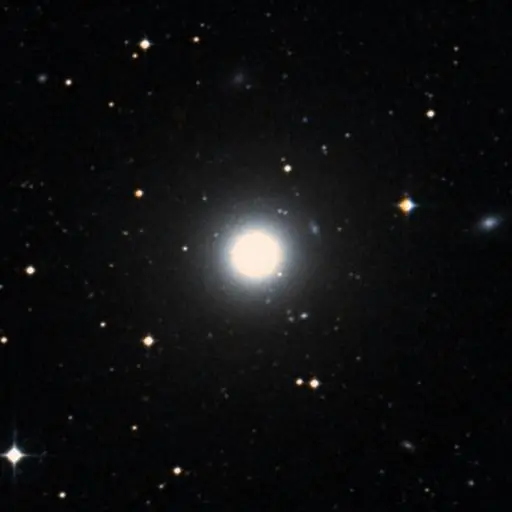
A perfectly round galaxy that seems to have almost no dark matter — a puzzle for cosmology.
Nearly every big galaxy seems to sit inside a heavy cocoon of invisible dark matter. NGC 7507 is an odd one out. This massive, almost perfectly round elliptical galaxy behaves as though its stars account for nearly all of its mass — something today’s standard theory of the universe finds hard to explain. William Herschel found it on 30 October 1783. It leads a fairly lonely life, with one partner, the barred spiral NGC 7513.
NGC 7507 is 82 million light-years away: the light we see from it set off about 82 million years ago, when dinosaurs still walked the Earth.
Did you know?
- Two halos, two directions. Its stars form two halos that turn in opposite directions: the outer halo rotates one way, the inner halo the other.
- Short on globulars. NGC 7507 has only about a tenth as many globular clusters as comparable ellipticals — a population more like a spiral galaxy’s.
How big is it?
79% of the Milky Way’s width. Light itself takes 79,000 years to cross it. Shrink it to the length of a football pitch and our whole Solar System would be smaller than a bacterium. All told — stars, gas and dark matter — it weighs about 200 billion Suns.
A 10.0-magnitude elliptical galaxy (E) in Sculptor, about 3.3′ across.
When and where to see it
It is best placed in the evening sky around October, when it crosses the meridian at about 10 pm local time (around midnight in September). It can be seen from everywhere south of 61°N and never sets south of 61°S.
At its highest it stands 11° up from 50°N, 26° up from 35°N, 61° up from the equator, 84° up from 35°S.
Facts
- Type
- Galaxy
- Constellation
- Sculptor
- Designations
- NGC 7507
- Magnitude
- 10.0
- Apparent size
- 3.3′ × 3.2′
- Position
- RA 23h 12.1m, Dec −28° 32′ (J2000)
- Distance
- 82 million light-years
- Discovered
- William Herschel, 1783
Open AstroPilot to see when NGC 7507 is highest tonight from your location, how easy it is with your telescope or binoculars, and an eyepiece view.