Superman Galaxy (NGC 7479)
Superman Galaxy (NGC 7479) is a galaxy in the constellation Pegasus, magnitude 11.1, 3.6′ × 2.7′ across.
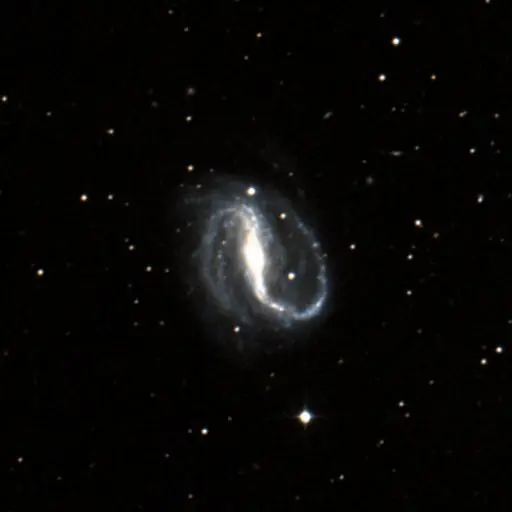
A galaxy shaped like the S on Superman’s chest, still shaken by swallowing a smaller neighbour.
Picture the emblem on Superman’s chest: a bold S. NGC 7479 draws something like it across the sky — a bright central bar with a curving spiral arm at each end — which is how it earned its nickname.
Behind the shape lies a collision. The galaxy’s arms are lopsided, and it is forming stars at a furious rate: in its core, in its outer arms and right along its bar, where most of the stars are less than 100 million years old. Astronomers blame a recent merger with a smaller galaxy.
Radio telescopes add a twist. In radio light, the arms open in the opposite direction to the arms we see in visible light — a feature not seen in any other galaxy. William Herschel discovered this barred spiral in 1784.
Superman Galaxy (NGC 7479) is 110 million light-years away: the light we see from it set off about 110 million years ago, when dinosaurs still walked the Earth.
Did you know?
- An active heart. Its core is classed as a Seyfert nucleus, where gas falling towards a central supermassive black hole shines brightly.
- Two stripped stars. Automated searches have caught two supernovae here, SN 1990U and SN 2009jf. Both were massive stars that had lost their outer layers before they exploded.
- A famous look-alike. In size and shape it closely resembles NGC 1300 in Eridanus, one of the best-known barred spirals of all.
How big is it?
1.2 times as wide as our Milky Way. Light itself takes 120,000 years to cross it. Shrink it to the length of a football pitch and our whole Solar System would be smaller than a bacterium.
A barred spiral in Pegasus with a prominent bar, which shows as an elongated glow in medium telescopes.
When and where to see it
It is best placed in the evening sky around October, when it crosses the meridian at about 10 pm local time (around midnight in September). It can be seen from everywhere north of 78°S and never sets north of 78°N.
At its highest it stands 52° up from 50°N, 67° up from 35°N, 78° up from the equator, 43° up from 35°S.
Facts
- Type
- Galaxy
- Constellation
- Pegasus
- Designations
- NGC 7479, C 44
- Magnitude
- 11.1
- Apparent size
- 3.6′ × 2.7′
- Position
- RA 23h 4.9m, Dec +12° 19′ (J2000)
- Distance
- 110 million light-years
- Discovered
- William Herschel, 1784
Open AstroPilot to see when Superman Galaxy (NGC 7479) is highest tonight from your location, how easy it is with your telescope or binoculars, and an eyepiece view.