NGC 7424
NGC 7424 is a galaxy in the constellation Grus, magnitude 10.2, 5.0′ × 2.7′ across.
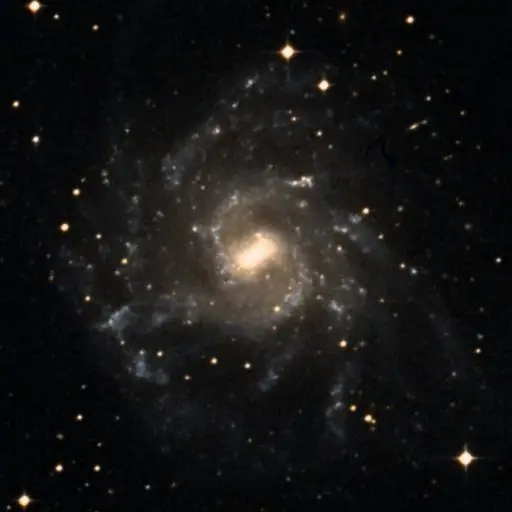
A ‘grand design’ spiral in Grus, where Hubble photographed the star that survived a supernova.
Astronomers call NGC 7424 a ‘grand design’ spiral galaxy for its well-defined arms, and it is similar in size to our own Milky Way. Its bar glows reddish with older stars, while the loose arms shine blue with clusters of massive young ones.
In December 2001 Robert Evans, the Australian amateur famed for hunting supernovae, found one on the galaxy’s outer edge. SN 2001ig was a rare Type IIb: hydrogen showed in its light at first, then faded, leaving lines of oxygen, calcium and magnesium.
NGC 7424 is 44 million light-years away: the light we see from it set off about 44 million years ago, when mammals were taking over a world without dinosaurs.
Did you know?
- A survivor caught on camera. In 2018 astronomers reported that Hubble had imaged SN 2001ig’s surviving companion star in ultraviolet light — the first companion of a Type IIb supernova ever seen.
- Two X-ray puzzles. In 2002 the Chandra X-ray Observatory found two ultraluminous X-ray sources here, shining more brightly than known stellar processes easily explain. One brightened tenfold in just 20 days.
How big is it?
64% of the Milky Way’s width. Light itself takes 64,000 years to cross it. Shrink it to the length of a football pitch and our whole Solar System would be smaller than a bacterium.
A 10.2-magnitude spiral galaxy (Sc) in Grus, about 5′ × 2.7′.
When and where to see it
It is best placed in the evening sky around October, when it crosses the meridian at about 10 pm local time (around midnight in September). It can be seen from everywhere south of 49°N and never sets south of 49°S.
At its highest it stands below the horizon from 50°N, 14° up from 35°N, 49° up from the equator, 84° up from 35°S.
Facts
- Type
- Galaxy
- Constellation
- Grus
- Designations
- NGC 7424
- Magnitude
- 10.2
- Apparent size
- 5.0′ × 2.7′
- Position
- RA 22h 57.3m, Dec −41° 4′ (J2000)
- Distance
- 44 million light-years
- Discovered
- John Herschel, 1834
Open AstroPilot to see when NGC 7424 is highest tonight from your location, how easy it is with your telescope or binoculars, and an eyepiece view.