NGC 7331 (C 30)
NGC 7331 (C 30) is a galaxy in the constellation Pegasus, magnitude 9.4, 9.3′ × 3.8′ across.
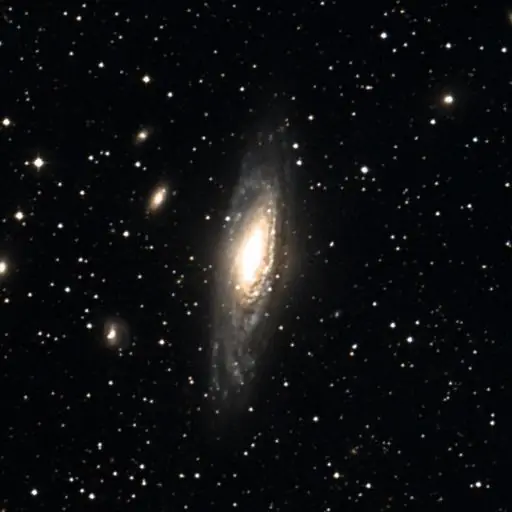
A spiral whose heart spins the wrong way — and the host of the brightest supernova of 2025.
Its centre spins the wrong way. In most spiral galaxies the central bulge turns along with the disc around it, but in NGC 7331 the two rotate in opposite directions. Its core also sits slightly off-centre, with one side of the disc reaching farther out than the other.
For years it was called “the Milky Way’s twin”, for its similar size and structure. The comparison has faded since we learned that our galaxy has a central bar, and NGC 7331 has none. The faint galaxies that seem to huddle around it are not companions either: they lie far in the background, lined up by chance.
William Herschel discovered this spiral galaxy on 6 September 1784. Five supernovae have been confirmed in it since. In July 2025 the GOTO survey found one that climbed to magnitude 11.9, the brightest supernova of the year, and in September 2026 ATLAS caught another.
NGC 7331 (C 30) is 48 million light-years away: the light we see from it set off about 48 million years ago, when mammals were taking over a world without dinosaurs.
Did you know?
- A supernova that changed. SN 2014C began as a hydrogen-poor Type Ib explosion, then over the course of a year turned into a hydrogen-rich Type IIn — an unusual “metamorphosis” for a supernova.
- An old plate’s secret. A photographic plate taken at Yerkes Observatory in 1903 shows a faint point of light here that may have been an earlier supernova.
- From mule driver to astronomer. The first confirmed supernova here, SN 1959D, was found at Palomar by Milton Humason and Howard Gates. Humason began by driving mule trains up Mount Wilson and became Edwin Hubble’s key collaborator.
How big is it?
1.3 times as wide as our Milky Way. Light itself takes 130,000 years to cross it. Shrink it to the length of a football pitch and our whole Solar System would be smaller than a bacterium.
A bright spiral in Pegasus often likened to the Milky Way. A few faint background galaxies nearby form the 'Deer Lick Group', and Stephan's Quintet lies half a degree away.
When and where to see it
It is best placed in the evening sky around October, when it crosses the meridian at about 10 pm local time (around midnight in August). It can be seen from everywhere north of 56°S and never sets north of 56°N.
At its highest it stands 74° up from 50°N, 89° up from 35°N, 56° up from the equator, 21° up from 35°S.
Facts
- Type
- Galaxy
- Constellation
- Pegasus
- Designations
- C 30
- Magnitude
- 9.4
- Apparent size
- 9.3′ × 3.8′
- Position
- RA 22h 37.1m, Dec +34° 25′ (J2000)
- Distance
- 48 million light-years
- Discovered
- William Herschel, 1784
Open AstroPilot to see when NGC 7331 (C 30) is highest tonight from your location, how easy it is with your telescope or binoculars, and an eyepiece view.