NGC 7295 (NGC 7296)
NGC 7295 (NGC 7296) is an open cluster in the constellation Lacerta, magnitude 9.7, 2.7′ across.
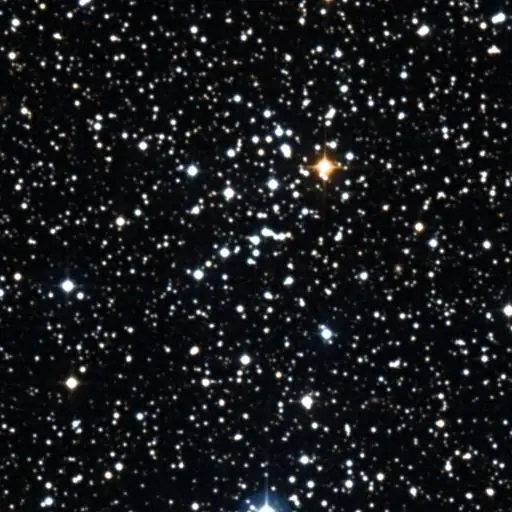
A small star cluster in Lacerta, the Lizard — a constellation pieced together from faint stars in the 1680s.
Lacerta, the Lizard, is one of the sky’s latecomers. Johannes Hevelius, the great astronomer of Gdańsk, made it up in the late 1600s from faint stars squeezed between Cygnus and Andromeda. The Milky Way runs through it, and with it a scattering of star clusters. This small open cluster is one of them: a group of stars born together and still travelling side by side. Catalogues know it by two numbers, NGC 7295 and NGC 7296.
NGC 7295 (NGC 7296) is 7,900 light-years away: the light we see from it set off around 5880 BC, 370 years before the first towns were growing in the Fertile Crescent.
How big is it?
Born about 370 million years ago, when the first plants and animals were moving onto land. Light itself takes 6.2 years to cross it. Gaia has picked out 171 stars moving together through space as its members. That’s 1.5 times the distance from the Sun to the nearest star. Shrink our Solar System — the Sun and all eight planets — to the size of a coin, and NGC 7295 would be 157 m across (about the length of a football pitch); the nearest star would be a football pitch away, and the Milky Way 2,520 km across.
A 9.7-magnitude open cluster in Lacerta, about 2.7′ across.
When and where to see it
It is best placed in the evening sky around October, when it crosses the meridian at about 10 pm local time (around midnight in August). It can be seen from everywhere north of 38°S and never sets north of 38°N.
At its highest it stands 88° up from 50°N, 73° up from 35°N, 38° up from the equator, 3° up from 35°S.
Facts
- Type
- Open cluster
- Constellation
- Lacerta
- Designations
- NGC 7296
- Magnitude
- 9.7
- Apparent size
- 2.7′
- Position
- RA 22h 28.1m, Dec +52° 17′ (J2000)
- Distance
- 7,900 light-years
Open AstroPilot to see when NGC 7295 (NGC 7296) is highest tonight from your location, how easy it is with your telescope or binoculars, and an eyepiece view.