Helix Nebula (NGC 7293)
Helix Nebula (NGC 7293) is a planetary nebula in the constellation Aquarius, magnitude 7.3, 16′ across.
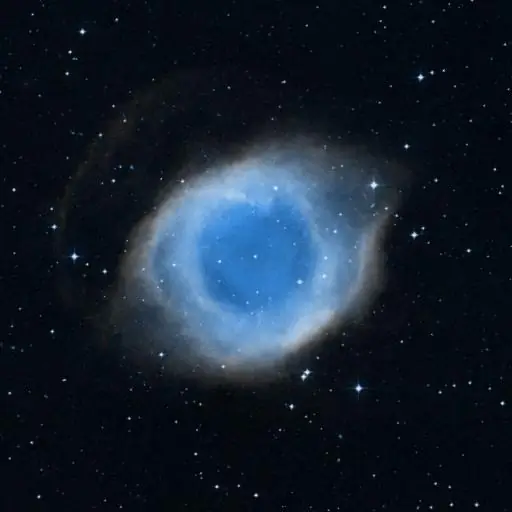
The “Eye of God”: a dying star’s cast-off layers, studded with some 40,000 comet-like knots.
Look at a photograph of the Helix and it seems to look back. Its glowing rings have earned it nicknames like the “Eye of God” and the “Eye of Sauron”. What it really shows is the end of a star.
A low- to intermediate-mass star shed its outer layers here, beginning around 10,600 years ago. What remains is a white dwarf of about 120,000 degrees, only a few times wider than Earth, whose ultraviolet glare makes the cast-off gas glow. This is a planetary nebula — the fate that awaits the Sun.
Look closer and the Helix is full of “cometary knots”, some 40,000 of them, each with a bright head facing the star and a tail streaming away. Leave off the tail and each knot is about as big as our whole Solar System. The Helix was the first planetary nebula in which such knots were found.
Helix Nebula (NGC 7293) is 650 light-years away: the light we see from it set off around 1375, 80 years before Gutenberg printed his Bible.
Did you know?
- Juno’s discoverer. Karl Ludwig Harding, who found the Helix — most likely before 1824 — is better known for discovering Juno in 1804, only the third asteroid ever found.
- Comets around a dead star. Dust glowing in infrared around the white dwarf seems to be topped up by thousands of comets on stretched orbits, perhaps from a cloud like the Sun’s own Oort cloud.
- A planet’s last meal?. A 2025 X-ray study suggested the white dwarf may be swallowing the remains of a Jupiter-like planet. A 2024 study hinted at another, smaller planet, but that is far from certain.
How big is it?
3,250 Solar Systems side by side. Light itself takes 3.1 years to cross it. It holds about one Sun’s worth of material. Shrink our Solar System — the Sun and all eight planets — to the size of a coin, and the Helix Nebula would be 77.9 m across (about the length of a football pitch); the nearest star would be a football pitch away, and the Milky Way 2,520 km across.
One of the nearest planetary nebulae, about 650 light-years away, and the largest in the sky; its faint ring needs dark skies, low power and an OIII filter.
When and where to see it
It is best placed in the evening sky around October, when it crosses the meridian at about 10 pm local time (around midnight in August). It can be seen from everywhere south of 69°N and never sets south of 69°S.
At its highest it stands 19° up from 50°N, 34° up from 35°N, 69° up from the equator, 76° up from 35°S.
Facts
- Type
- Planetary nebula
- Constellation
- Aquarius
- Designations
- NGC 7293, C 63
- Magnitude
- 7.3
- Apparent size
- 16′
- Position
- RA 22h 29.6m, Dec −20° 50′ (J2000)
- Distance
- 650 light-years
- Discovered
- Karl Ludwig Harding, 1824, Most likely found before 1824
Open AstroPilot to see when Helix Nebula (NGC 7293) is highest tonight from your location, how easy it is with your telescope or binoculars, and an eyepiece view.