NGC 7261
NGC 7261 is an open cluster in the constellation Cepheus, magnitude 8.4, 6.9′ across.
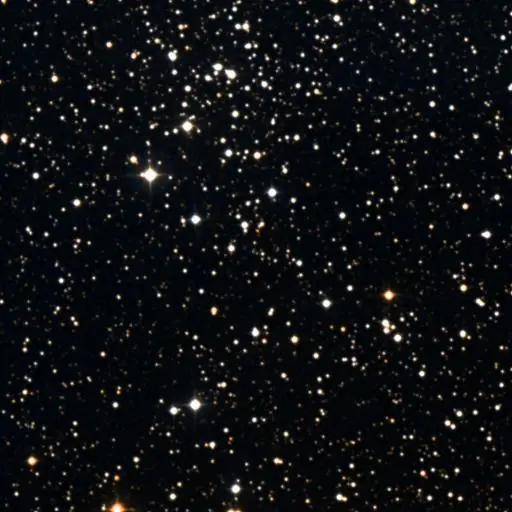
A little-known family of stars in Cepheus, a short hop from the star that gave Cepheid variables their name.
Every star in an open cluster shares a birthplace: the members of NGC 7261 formed together from a single cloud of gas and dust, and have travelled through the Milky Way as a group ever since. Its neighbour in the sky is far more famous. A little over a degree away shines Delta Cephei, whose steady pulsing gave its name to the Cepheid variable stars — the yardsticks Edwin Hubble used to prove that other galaxies lie far beyond our own.
NGC 7261 is 11,000 light-years away: the light we see from it set off around 8980 BC, 530 years after the stone pillars of Göbekli Tepe, the oldest known temple, were raised.
How big is it?
Born about 45 million years ago, when mammals were taking over a world without dinosaurs. Light itself takes 22 years to cross it. Gaia has picked out 117 stars moving together through space as its members. That’s 5.2 times the distance from the Sun to the nearest star. Shrink our Solar System — the Sun and all eight planets — to the size of a coin, and NGC 7261 would be 557 m across (5 football pitches end to end); the nearest star would be a football pitch away, and the Milky Way 2,520 km across.
An 8.4-magnitude open cluster in Cepheus, about 6.9′ across.
When and where to see it
It is best placed in the evening sky around September, when it crosses the meridian at about 10 pm local time (around midnight in August). It can be seen from everywhere north of 32°S and never sets north of 32°N.
At its highest it stands 82° up from 50°N, 67° up from 35°N, 32° up from the equator, below the horizon from 35°S.
Facts
- Type
- Open cluster
- Constellation
- Cepheus
- Designations
- NGC 7261
- Magnitude
- 8.4
- Apparent size
- 6.9′
- Position
- RA 22h 20.1m, Dec +58° 3′ (J2000)
- Distance
- 11,000 light-years
Open AstroPilot to see when NGC 7261 is highest tonight from your location, how easy it is with your telescope or binoculars, and an eyepiece view.