NGC 7243 (C 16)
NGC 7243 (C 16) is an open cluster in the constellation Lacerta, magnitude 6.4, 21′ across.
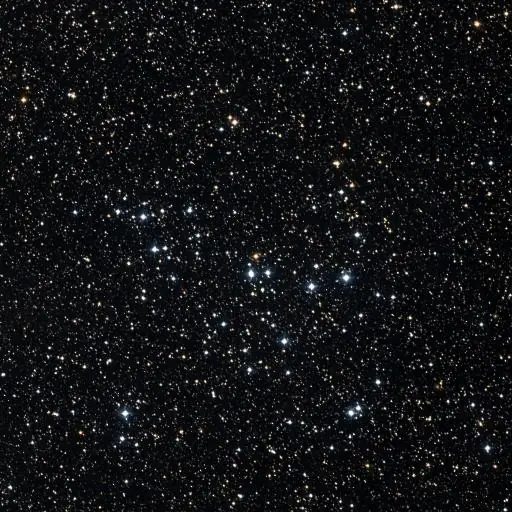
A quiet-looking cluster that a decade of watching revealed to be full of eclipsing and pulsing stars.
For a decade, astronomers kept returning to NGC 7243, measuring how each star’s light changed from night to night. By 2016 they had found 37 eclipsing binaries — pairs of stars that take turns passing in front of each other — along with 26 stars that pulse.
This open cluster is about 250 million years old: its stars were born around the time the first dinosaurs appeared on Earth. A 2003 study counted 211 likely members, with a combined mass of roughly 350 to 520 Suns.
William Herschel discovered it on 26 September 1788. It lies in Lacerta, the Lizard, a small constellation squeezed in between Cygnus and Andromeda by Johannes Hevelius in the late 1600s.
NGC 7243 (C 16) is 2,800 light-years away: the light we see from it set off around 780 BC, around the time the first recorded Olympic Games were held.
Did you know?
- A planet candidate. The decade of monitoring also turned up one possible transiting planet: a small, regular dip in a star’s light as something passes in front of it. It has yet to be confirmed.
- Lost its heavyweights. Its hottest remaining star is a B5 giant, already ageing. Any more massive stars the cluster was born with have long since burnt out.
How big is it?
Born about 150 million years ago, when dinosaurs were rising and the supercontinent Pangaea was breaking apart. Light itself takes 17 years to cross it. Gaia has picked out 503 stars moving together through space as its members. That’s 4 times the distance from the Sun to the nearest star. Shrink our Solar System — the Sun and all eight planets — to the size of a coin, and NGC 7243 would be 432 m across (4 football pitches end to end); the nearest star would be a football pitch away, and the Milky Way 2,520 km across.
A large, loose open cluster in Lacerta, best at low power, where its brighter stars stand out against the Milky Way.
When and where to see it
It is best placed in the evening sky around September, when it crosses the meridian at about 10 pm local time (around midnight in August). It can be seen from everywhere north of 40°S and never sets north of 40°N.
At its highest it stands 90° up from 50°N, 75° up from 35°N, 40° up from the equator, 5° up from 35°S.
Facts
- Type
- Open cluster
- Constellation
- Lacerta
- Designations
- C 16
- Magnitude
- 6.4
- Apparent size
- 21′
- Position
- RA 22h 15.1m, Dec +49° 54′ (J2000)
- Distance
- 2,800 light-years
- Discovered
- William Herschel, 1788
Open AstroPilot to see when NGC 7243 (C 16) is highest tonight from your location, how easy it is with your telescope or binoculars, and an eyepiece view.