NGC 7226
NGC 7226 is an open cluster in the constellation Cepheus, magnitude 9.6, 3.0′ across.
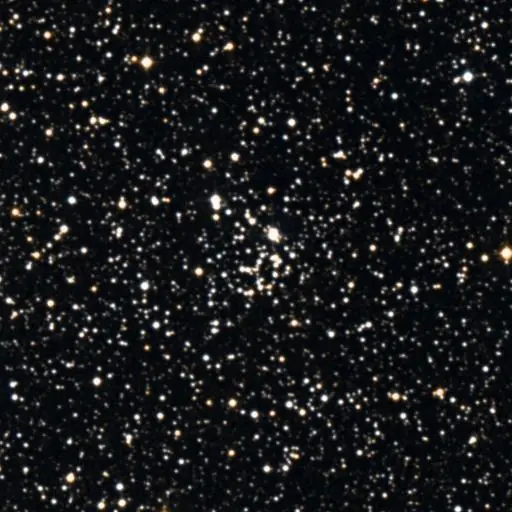
An open cluster in Cepheus, the constellation of the star that gave Cepheid variables their name.
Cepheus holds a star that changed astronomy: Delta Cephei, whose regular pulsing John Goodricke discovered in 1784. Its kind, the Cepheids, later let astronomers measure the distances to other galaxies. NGC 7226 is a far humbler resident of the constellation, an open cluster whose stars were born together and still drift through the milky way as a group.
NGC 7226 is 16,000 light-years away: the light we see from it set off about 16,000 years ago, when the last Ice Age was at its height, and mammoths roamed beneath the ice sheets.
How big is it?
Born about 480 million years ago, when the first plants and animals were moving onto land. Light itself takes 14 years to cross it. Gaia has picked out 74 stars moving together through space as its members. That’s 3.3 times the distance from the Sun to the nearest star. Shrink our Solar System — the Sun and all eight planets — to the size of a coin, and NGC 7226 would be 352 m across (3 football pitches end to end); the nearest star would be a football pitch away, and the Milky Way 2,520 km across.
A 9.6-magnitude open cluster in Cepheus, about 3′ across.
When and where to see it
It is best placed in the evening sky around September, when it crosses the meridian at about 10 pm local time (around midnight in August). It can be seen from everywhere north of 35°S and never sets north of 35°N.
At its highest it stands 85° up from 50°N, 70° up from 35°N, 35° up from the equator, below the horizon from 35°S.
Facts
- Type
- Open cluster
- Constellation
- Cepheus
- Designations
- NGC 7226
- Magnitude
- 9.6
- Apparent size
- 3.0′
- Position
- RA 22h 10.4m, Dec +55° 24′ (J2000)
- Distance
- 16,000 light-years
Open AstroPilot to see when NGC 7226 is highest tonight from your location, how easy it is with your telescope or binoculars, and an eyepiece view.