NGC 7217
NGC 7217 is a galaxy in the constellation Pegasus, magnitude 10.5, 4.5′ × 3.8′ across.
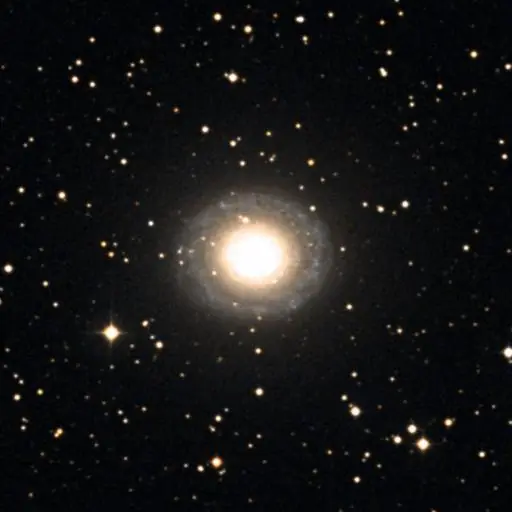
A ringed spiral galaxy with stars orbiting the wrong way — clues to a merger long ago.
Rings within rings mark NGC 7217. Three main rings of stars circle its core, the outermost holding most of its gas and new stars, and Hubble found still smaller rings inside the innermost — signs that its centre has gone through several bursts of star formation.
Something else hints at a turbulent past: some of its stars orbit the centre in the opposite direction to the rest. A merger with one or two smaller, gas-rich galaxies may explain it, perhaps turning a lenticular galaxy into the spiral galaxy we see today. Now it floats alone, with no large companions. William Herschel found it in 1784.
NGC 7217 is 55 million light-years away: the light we see from it set off about 55 million years ago, when mammals were taking over a world without dinosaurs.
How big is it?
72% of the Milky Way’s width. Light itself takes 72,000 years to cross it. Shrink it to the length of a football pitch and our whole Solar System would be smaller than a bacterium.
A 10.5-magnitude spiral galaxy (Sab) in Pegasus, about 4.5′ × 3.8′.
When and where to see it
It is best placed in the evening sky around September, when it crosses the meridian at about 10 pm local time (around midnight in August). It can be seen from everywhere north of 59°S and never sets north of 59°N.
At its highest it stands 71° up from 50°N, 86° up from 35°N, 59° up from the equator, 24° up from 35°S.
Facts
- Type
- Galaxy
- Constellation
- Pegasus
- Designations
- NGC 7217
- Magnitude
- 10.5
- Apparent size
- 4.5′ × 3.8′
- Position
- RA 22h 7.9m, Dec +31° 22′ (J2000)
- Distance
- 55 million light-years
- Discovered
- William Herschel, 1784
Open AstroPilot to see when NGC 7217 is highest tonight from your location, how easy it is with your telescope or binoculars, and an eyepiece view.