NGC 7209
NGC 7209 is an open cluster in the constellation Lacerta, magnitude 7.7, 14′ across.
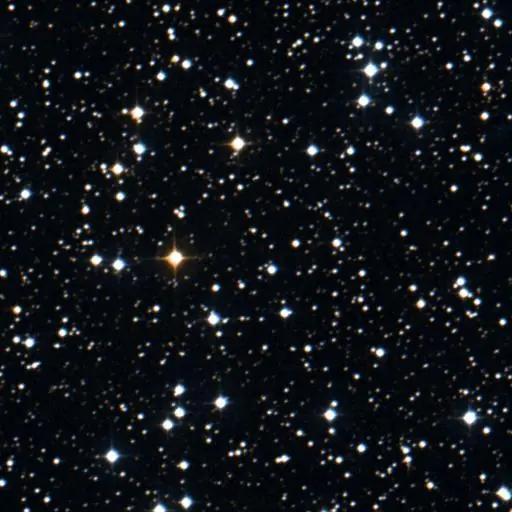
Home of SS Lacertae, a pair of stars that stopped eclipsing each other in the mid-20th century.
For decades, SS Lacertae dimmed every 14.4 days as one of its two stars passed in front of the other. Then, in the middle of the 20th century, the eclipses stopped. The culprit is a third star, circling the pair every 679 days. Its pull slowly tilts their orbit, so that from Earth they no longer line up.
The tilt cycles round in about 600 years, bringing two spells of eclipses that each last about a century. SS Lacertae belongs to NGC 7209, an open cluster of some 150 stars that William Herschel found on 19 October 1787.
NGC 7209 is 3,900 light-years away: the light we see from it set off around 1880 BC, 550 years before Tutankhamun was buried in the Valley of the Kings.
How big is it?
Born about 430 million years ago, when the first plants and animals were moving onto land. Light itself takes 16 years to cross it. Gaia has picked out 504 stars moving together through space as its members. That’s 3.7 times the distance from the Sun to the nearest star. Shrink our Solar System — the Sun and all eight planets — to the size of a coin, and NGC 7209 would be 401 m across (4 football pitches end to end); the nearest star would be a football pitch away, and the Milky Way 2,520 km across.
A 7.7-magnitude open cluster in Lacerta, about 14′ across.
When and where to see it
It is best placed in the evening sky around September, when it crosses the meridian at about 10 pm local time (around midnight in August). It can be seen from everywhere north of 44°S and never sets north of 44°N.
At its highest it stands 86° up from 50°N, 79° up from 35°N, 44° up from the equator, 9° up from 35°S.
Facts
- Type
- Open cluster
- Constellation
- Lacerta
- Designations
- NGC 7209
- Magnitude
- 7.7
- Apparent size
- 14′
- Position
- RA 22h 5.1m, Dec +46° 29′ (J2000)
- Distance
- 3,900 light-years
- Discovered
- William Herschel, 1787
Open AstroPilot to see when NGC 7209 is highest tonight from your location, how easy it is with your telescope or binoculars, and an eyepiece view.