NGC 720
NGC 720 is a galaxy in the constellation Cetus, magnitude 10.1, 4.5′ × 2.4′ across.
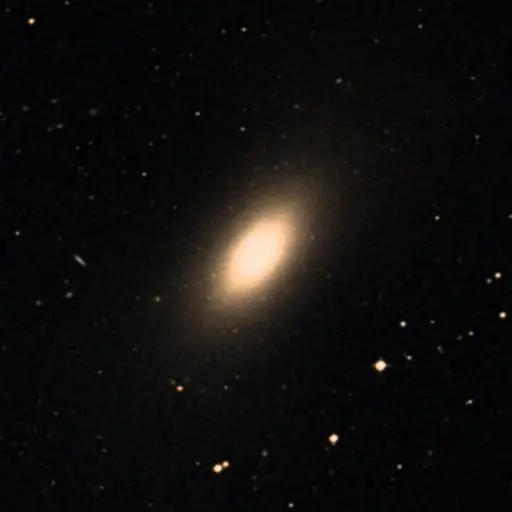
An elliptical galaxy whose tilted halo of hot gas betrays a hidden mass.
In 2000 the Chandra X-ray Observatory noticed something odd about NGC 720. This elliptical galaxy is wrapped in a flattened halo of hot gas, and the halo is tilted differently from the starlight we see. The mismatch fits the idea that most of the gravity comes from unseen dark matter, though some alternative theories of gravity can explain it too. Counting that hidden mass, the galaxy weighs about three trillion Suns.
Its centre holds stars about 13 billion years old, and some 1,500 globular clusters swarm around it. William Herschel discovered it on 3 October 1785.
NGC 720 is 90 million light-years away: the light we see from it set off about 90 million years ago, when dinosaurs still walked the Earth.
Did you know?
- X-ray hotspots. NGC 720 hosts nine ultraluminous X-ray sources — as of 2003, the most found in any galaxy of its smooth, early type.
- A past merger. Its stars change in age from the centre outwards. Astronomers have proposed that NGC 720 swallowed a smaller galaxy about 4 billion years ago.
How big is it?
1.2 times as wide as our Milky Way. Light itself takes 120,000 years to cross it. Shrink it to the length of a football pitch and our whole Solar System would be smaller than a bacterium.
A 10.1-magnitude elliptical galaxy (E) in Cetus, about 4.5′ × 2.4′.
When and where to see it
It is best placed in the evening sky around November, when it crosses the meridian at about 10 pm local time (around midnight in October). It can be seen from everywhere south of 76°N and never sets south of 76°S.
At its highest it stands 26° up from 50°N, 41° up from 35°N, 76° up from the equator, 69° up from 35°S.
Facts
- Type
- Galaxy
- Constellation
- Cetus
- Designations
- NGC 720
- Magnitude
- 10.1
- Apparent size
- 4.5′ × 2.4′
- Position
- RA 1h 53.0m, Dec −13° 44′ (J2000)
- Distance
- 90 million light-years
- Discovered
- William Herschel, 1785
Open AstroPilot to see when NGC 720 is highest tonight from your location, how easy it is with your telescope or binoculars, and an eyepiece view.