NGC 7160
NGC 7160 is an open cluster in the constellation Cepheus, magnitude 6.1, 4.2′ across.
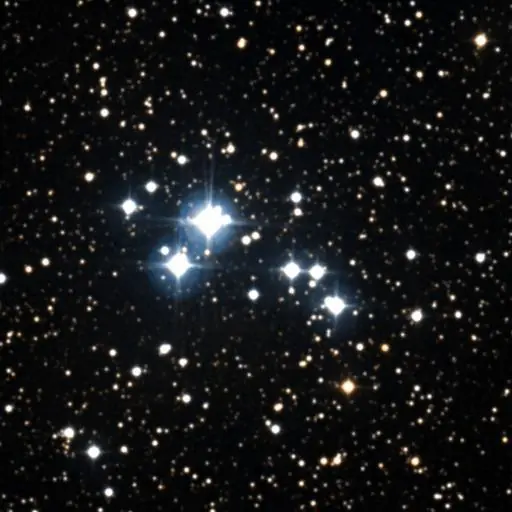
A young cluster inside the Cepheus Bubble, a vast shell blown by stars that have since exploded.
NGC 7160 lives inside a giant bubble. The Cepheus Bubble, a dusty shell spanning about ten degrees of sky, was blown out by the winds and light of massive stars that later died as supernovae. This young open cluster, 10 to 19 million years old, may once have been their companion, along with Mu Cephei — Herschel’s Garnet Star — and Nu Cephei.
The gas it formed from is already gone. Yet one small, cool member is still feeding from a disc of material, perhaps one in which planets could form.
NGC 7160 is 2,900 light-years away: the light we see from it set off around 880 BC, around the time the first recorded Olympic Games were held.
Did you know?
- Runaways. It has been suggested that the bright stars Lambda Cephei and 68 Cygni are runaways, flung out at high speed from this same region.
How big is it?
Born about 14 million years ago, when great apes were spreading through Africa and Europe. Light itself takes 3.5 years to cross it. Gaia has picked out 151 stars moving together through space as its members. That’s about as wide as the distance from the Sun to the nearest star. Shrink our Solar System — the Sun and all eight planets — to the size of a coin, and NGC 7160 would be 89.4 m across (about the length of a football pitch); the nearest star would be a football pitch away, and the Milky Way 2,520 km across.
A 6.1-magnitude open cluster in Cepheus, about 4.2′ across.
When and where to see it
It is best placed in the evening sky around September, when it crosses the meridian at about 10 pm local time (around midnight in August). It can be seen from everywhere north of 27°S and never sets north of 27°N.
At its highest it stands 77° up from 50°N, 62° up from 35°N, 27° up from the equator, below the horizon from 35°S.
Facts
- Type
- Open cluster
- Constellation
- Cepheus
- Designations
- NGC 7160
- Magnitude
- 6.1
- Apparent size
- 4.2′
- Position
- RA 21h 53.7m, Dec +62° 36′ (J2000)
- Distance
- 2,900 light-years
- Discovered
- William Herschel, 1789
Open AstroPilot to see when NGC 7160 is highest tonight from your location, how easy it is with your telescope or binoculars, and an eyepiece view.