NGC 7031
NGC 7031 is an open cluster in the constellation Cygnus, magnitude 9.1, 14′ across.
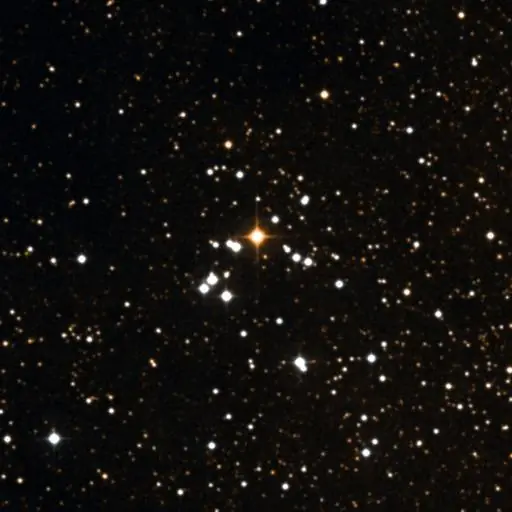
A small open cluster in Cygnus, where we look along the length of our own spiral arm.
William Herschel found this small open cluster on 21 September 1788. It lies in Cygnus, and that matters: when we look towards the Swan, we are looking along the length of our own spiral arm of the Milky Way, so clusters, nebulae and star fields pile up one behind another. NGC 7031 is one of the many in that crowded view.
NGC 7031 is 4,300 light-years away: the light we see from it set off around 2280 BC, 290 years after the Great Pyramid of Giza was completed.
How big is it?
Born about 150 million years ago, when dinosaurs were rising and the supercontinent Pangaea was breaking apart. Light itself takes 18 years to cross it. Gaia has picked out 264 stars moving together through space as its members. That’s 4.1 times the distance from the Sun to the nearest star. Shrink our Solar System — the Sun and all eight planets — to the size of a coin, and NGC 7031 would be 442 m across (4 football pitches end to end); the nearest star would be a football pitch away, and the Milky Way 2,520 km across.
A 9.1-magnitude open cluster in Cygnus, about 14′ across.
When and where to see it
It is best placed in the evening sky around September, when it crosses the meridian at about 10 pm local time (around midnight in August). It can be seen from everywhere north of 39°S and never sets north of 39°N.
At its highest it stands 89° up from 50°N, 74° up from 35°N, 39° up from the equator, 4° up from 35°S.
Facts
- Type
- Open cluster
- Constellation
- Cygnus
- Designations
- NGC 7031
- Magnitude
- 9.1
- Apparent size
- 14′
- Position
- RA 21h 7.2m, Dec +50° 53′ (J2000)
- Distance
- 4,300 light-years
- Discovered
- William Herschel, 1788
Open AstroPilot to see when NGC 7031 is highest tonight from your location, how easy it is with your telescope or binoculars, and an eyepiece view.