NGC 7027
NGC 7027 is a planetary nebula in the constellation Cygnus, magnitude 8.5, 14″ across.
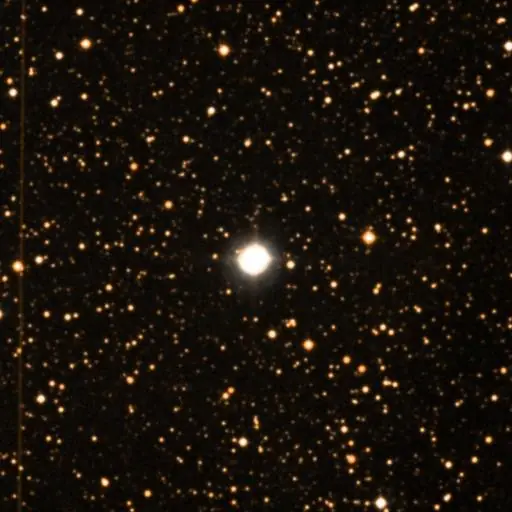
One of the youngest planetary nebulae known — where the universe’s first kind of molecule was finally found.
Around six centuries ago, a star three or four times heavier than the Sun began to shed its outer layers. NGC 7027 is the result: a planetary nebula so young and compact that astronomers once thought its central star was still too cool to light it up. Hubble showed otherwise. It is a planetary nebula at the very start of its life.
Édouard Stephan found it in 1878 with the 80-centimetre reflector at Marseille Observatory. Nicknamed the Jewel Bug and the Magic Carpet, it is by far the most studied planetary nebula.
NGC 7027 is 3,600 light-years away: the light we see from it set off around 1580 BC, 250 years before Tutankhamun was buried in the Valley of the Kings.
Did you know?
- The first molecule. In 2019 the helium hydride ion — thought to be the first molecule to form in the universe, about 100,000 years after the Big Bang — was detected in space for the first time, here.
- Escaping a supernova. Its outer halo holds about three Suns’ worth of cast-off gas. Mass loss like this showed that stars a few times heavier than the Sun can shed enough to avoid exploding as supernovae.
- Carbon and diamonds. The nebula is rich in carbon, and there is evidence that it contains nanodiamonds — specks of diamond only billionths of a metre across.
How big is it?
253 Solar Systems side by side. Light itself takes 3 months to cross it. Shrink our Solar System — the Sun and all eight planets — to the size of a coin, and NGC 7027 would be 6.1 m across (about the length of a car); the nearest star would be a football pitch away, and the Milky Way 2,520 km across.
An 8.5-magnitude planetary nebula in Cygnus, about 14″ across. Its central star is magnitude 16.3.
When and where to see it
It is best placed in the evening sky around September, when it crosses the meridian at about 10 pm local time (around midnight in August). It can be seen from everywhere north of 48°S and never sets north of 48°N.
At its highest it stands 82° up from 50°N, 83° up from 35°N, 48° up from the equator, 13° up from 35°S.
Facts
- Type
- Planetary nebula
- Constellation
- Cygnus
- Designations
- NGC 7027
- Magnitude
- 8.5
- Apparent size
- 14″
- Position
- RA 21h 7.0m, Dec +42° 14′ (J2000)
- Distance
- 3,600 light-years
- Discovered
- Édouard Stephan, 1878
Open AstroPilot to see when NGC 7027 is highest tonight from your location, how easy it is with your telescope or binoculars, and an eyepiece view.