Iris Nebula (NGC 7023)
Iris Nebula (NGC 7023) is a reflection nebula in the constellation Cepheus, magnitude 7.2 (blue), 18′ across.
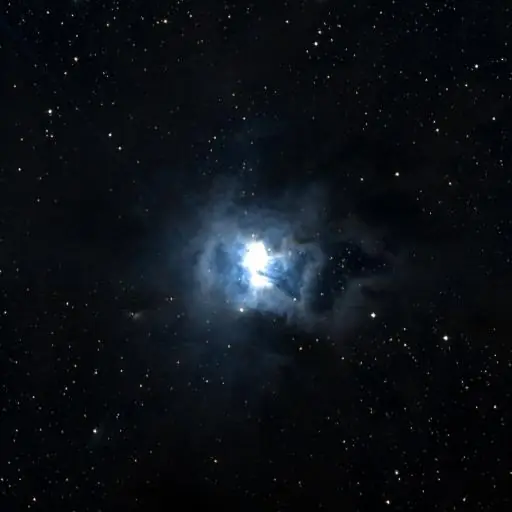
A dusty flower in Cepheus where a space telescope found carbon molecules shaped like footballs.
There are footballs in the Iris Nebula. Not real ones: in 2007 the Spitzer Space Telescope found buckyballs here, cage-shaped molecules of 60 carbon atoms arranged like the panels of a football. It was the first firm detection of neutral fullerenes in interstellar space, and they rank among the largest molecules ever found there.
The surprise was where they sat. Fullerenes were thought to be built in the hot, dense outskirts of old stars, yet here they lie in a cold, thin cloud bathed in ultraviolet light. One idea is that the starlight strips larger carbon molecules of their hydrogen, then folds them into cages that shrink until they reach the tidy 60-atom ball.
That light comes from HD 200775, a pair of young stars at the centre of this reflection nebula; their glow bounces off the surrounding dust. William Herschel discovered the nebula in 1794.
Iris Nebula (NGC 7023) is 1,400 light-years away: the light we see from it set off around AD 630, 90 years after the Hagia Sophia was completed in Constantinople.
Did you know?
- A nursery in the dust. New stars are still forming in the Iris. It holds the densest gathering of young stellar objects in the Cepheus Flare, a sprawl of dark clouds in this part of the sky.
- Hollowed out by its stars. Outflows from the young central stars have carved a two-sided, cone-shaped cavity in the cloud, and their light is breaking molecules apart along its glowing walls.
- Smoky chemistry. The nebula is also rich in polycyclic aromatic hydrocarbons — flat, honeycomb-patterned carbon molecules much like those found in soot and smoke on Earth.
How big is it?
1.7 times the distance from the Sun to the nearest star. Light itself takes 7.3 years to cross it. Shrink our Solar System — the Sun and all eight planets — to the size of a coin, and the Iris Nebula would be 185 m across (2 football pitches end to end); the nearest star would be a football pitch away, and the Milky Way 2,520 km across.
A reflection nebula in Cepheus lit by a 7th-magnitude star at its center; dark skies show a soft glow around the star. Filters do not help, and its intricate dust shows only in photographs.
When and where to see it
It is best placed in the evening sky around September, when it crosses the meridian at about 10 pm local time (around midnight in August). It can be seen from everywhere north of 22°S and never sets north of 22°N.
At its highest it stands 72° up from 50°N, 57° up from 35°N, 22° up from the equator, below the horizon from 35°S.
Facts
- Type
- Reflection nebula
- Constellation
- Cepheus
- Designations
- NGC 7023, C 4
- Magnitude
- 7.2 (blue)
- Apparent size
- 18′
- Position
- RA 21h 1.6m, Dec +68° 10′ (J2000)
- Distance
- 1,400 light-years
- Discovered
- William Herschel, 1794
Open AstroPilot to see when Iris Nebula (NGC 7023) is highest tonight from your location, how easy it is with your telescope or binoculars, and an eyepiece view.