Saturn Nebula (NGC 7009)
Saturn Nebula (NGC 7009) is a planetary nebula in the constellation Aquarius, magnitude 8.0, 42″ × 31″ across.
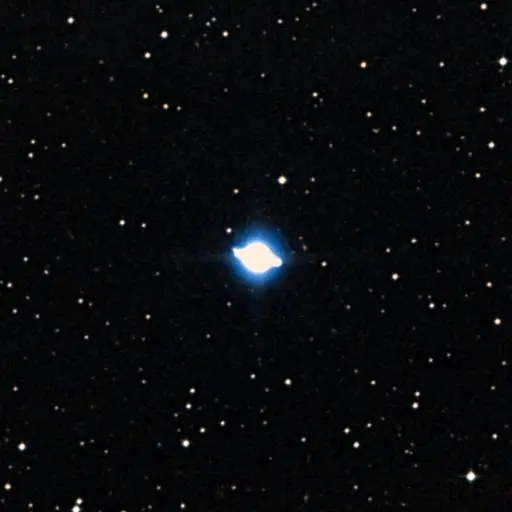
A dying star’s nebula that looks like a ringed planet — named by Lord Rosse in the 1840s.
In the 1840s Lord Rosse, working with some of the largest telescopes yet built, saw thin extensions poking out on either side of a small nebula in Aquarius, like Saturn’s rings seen edge-on. He gave it the name we still use: the Saturn Nebula.
Those “handles”, or ansae, turn out to be knots of gas moving outward from a dying star — though, oddly, not in straight lines away from it. This planetary nebula is made of the cast-off outer layers of a low-mass star. What remains at the centre is a hot white dwarf of about 55,000 degrees, whose ultraviolet light makes oxygen atoms in the nebula fluoresce green.
William Herschel had discovered it some sixty years earlier, on 7 September 1782, from his garden at Datchet near Windsor, using a telescope of his own design. It was one of the first finds of his great survey of the sky.
Saturn Nebula (NGC 7009) is 3,900 light-years away: the light we see from it set off around 1880 BC, 550 years before Tutankhamun was buried in the Valley of the Kings.
Did you know?
- One of Struve’s rarities. The 19th-century astronomer William Henry Smyth counted it among Struve’s nine “Rare Celestial Objects” — a select club of the sky’s most curious sights.
- Heading our way. The whole nebula is moving towards us at about 45 kilometres per second — fast enough to cross the Atlantic in about two minutes.
- Layers upon layers. Beyond its famous handles, the nebula has a faint halo, several shells, jet-like streams and small knots and filaments, all arranged in three dimensions.
How big is it?
835 Solar Systems side by side. Light itself takes 10 months to cross it. Shrink our Solar System — the Sun and all eight planets — to the size of a coin, and the Saturn Nebula would be 20 m across (about the length of a tennis court); the nearest star would be a football pitch away, and the Milky Way 2,520 km across.
A bright planetary nebula in Aquarius; high magnification shows the faint extensions on each side that make it look like Saturn seen edge-on.
When and where to see it
It is best placed in the evening sky around September, when it crosses the meridian at about 10 pm local time (around midnight in August). It can be seen from everywhere south of 79°N and never sets south of 79°S.
At its highest it stands 29° up from 50°N, 44° up from 35°N, 79° up from the equator, 66° up from 35°S.
Facts
- Type
- Planetary nebula
- Constellation
- Aquarius
- Designations
- NGC 7009, C 55
- Magnitude
- 8.0
- Apparent size
- 42″ × 31″
- Position
- RA 21h 4.2m, Dec −11° 22′ (J2000)
- Distance
- 3,900 light-years
- Discovered
- William Herschel, 1782
Open AstroPilot to see when Saturn Nebula (NGC 7009) is highest tonight from your location, how easy it is with your telescope or binoculars, and an eyepiece view.