North America Nebula (NGC 7000)
North America Nebula (NGC 7000) is an emission nebula in the constellation Cygnus, magnitude 4.0 (blue), 2.0° × 1.7° across.
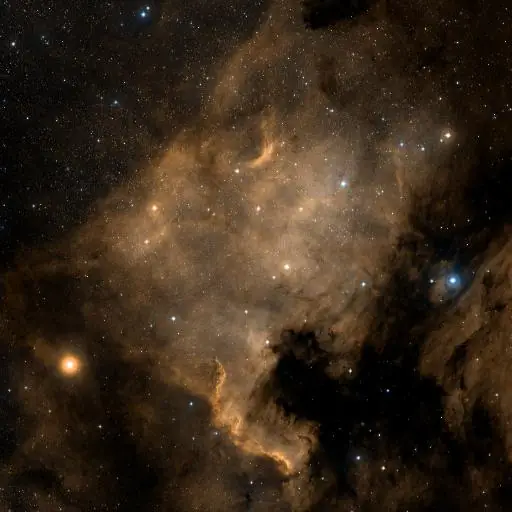
A glowing continent in Cygnus, lit by a hidden star that was only tracked down in 2004.
In 1890 the German astrophotographer Max Wolf took a long-exposure photograph of a patch of Cygnus and saw a familiar shape emerge: a glowing continent. He named it the North America Nebula. William Herschel had noted “faint milky nebulosity” here back in 1786, but only the camera revealed its outline.
For decades nobody knew what made it shine. In 1922 Edwin Hubble suggested nearby Deneb, but Deneb is not hot enough. By 1958 George Herbig realised the culprit had to be hidden behind a dark lane of dust. In 2004 Fernando Comerón and Anna Pasquali found it in infrared: a fierce O-type star of over 40,000 degrees, just off the nebula’s “Florida coast”. In 2026 the IAU named it the Bajamar Star.
The same dark lane splits one great cloud of glowing hydrogen in two: the North America and Pelican nebulae are parts of a single cloud. The stretch shaped like Mexico, the Cygnus Wall, is where stars are forming most intensely.
North America Nebula (NGC 7000) is 2,600 light-years away: the light we see from it set off around 580 BC, 135 years before the Parthenon was dedicated in Athens.
Did you know?
- Islands at low tide. The star’s name follows the map. “Islas de Bajamar”, the low-tide islands, was the original Spanish name for the Bahamas, just off Florida — many of them are easiest to see from a ship at low tide.
- Hidden in plain sight. The dark cloud in front dims the Bajamar Star almost 10,000 times. Without it, the star would shine at magnitude 3.6 — nearly as bright as Albireo, and easy to see with the naked eye.
- Runaways from Bermuda. The Bajamar Star and another hot star, nicknamed the Toronto star, both seem to have been flung out of a group dubbed the Bermuda cluster about 1.5 million years ago.
How big is it?
21 times the distance from the Sun to the nearest star. Light itself takes 91 years to cross it. Shrink our Solar System — the Sun and all eight planets — to the size of a coin, and the North America Nebula would be 2.29 km across (a 30-minute walk); the nearest star would be a football pitch away, and the Milky Way 2,520 km across.
A vast emission nebula near Deneb shaped like the North American continent. Visible to the naked eye from dark sites, it is best in binoculars or a wide-field telescope with a UHC filter.
When and where to see it
It is best placed in the evening sky around September, when it crosses the meridian at about 10 pm local time (around midnight in August). It can be seen from everywhere north of 45°S and never sets north of 45°N.
At its highest it stands 85° up from 50°N, 80° up from 35°N, 45° up from the equator, 10° up from 35°S.
Facts
- Type
- Emission nebula
- Constellation
- Cygnus
- Designations
- NGC 7000, C 20
- Magnitude
- 4.0 (blue)
- Apparent size
- 2.0° × 1.7°
- Position
- RA 20h 59.3m, Dec +44° 32′ (J2000)
- Distance
- 2,600 light-years
- Discovered
- William Herschel, 1786, Named the North America Nebula by Max Wolf in 1890
Open AstroPilot to see when North America Nebula (NGC 7000) is highest tonight from your location, how easy it is with your telescope or binoculars, and an eyepiece view.