East Veil Nebula (NGC 6992)
East Veil Nebula (NGC 6992) is a supernova remnant in the constellation Cygnus, magnitude 7.0 (blue), 1.0° × 8.0′ across.
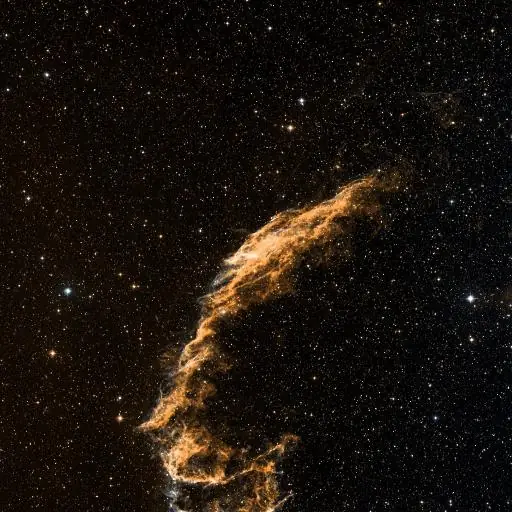
The brightest arc of a supernova’s wreckage — still expanding fast enough for Hubble to watch it move.
Compare pictures of the Eastern Veil taken years apart and you can see it move. Between 1997 and 2015 the Hubble Space Telescope did exactly that, catching the debris of an exploded star as it ploughs outward at around 1.5 million kilometres per hour.
The star, roughly 20 times the Sun’s mass, blew up 10,000 to 20,000 years ago. Its expanding shell, the Cygnus Loop, now spreads across a patch of sky many times wider than the full Moon, and NGC 6992 is the brightest arc of this supernova remnant. Heated by the blast, atoms of oxygen, sulphur and hydrogen glow in its tangled filaments. Together with NGC 6995 to the south, it forms the Network Nebula.
William Herschel came across it on 5 September 1784 and described “branching nebulosity” whose streams divide and then unite again towards the south.
East Veil Nebula (NGC 6992) is 2,400 light-years away: the light we see from it set off around 380 BC, around the time the Parthenon was dedicated in Athens.
Did you know?
- Fleming’s triangle. Between the Eastern and Western Veils lies a fainter wisp found on photographs in 1904 by Williamina Fleming. As was the custom of the day, credit went to her boss, Edward Pickering: it is still called Pickering’s Triangle.
- Loud in radio and X-rays. The Cygnus Loop shines far beyond visible light: it is a strong source of both radio waves and X-rays, from gas the blast has heated.
How big is it?
9.9 times the distance from the Sun to the nearest star. Light itself takes 42 years to cross it. Shrink our Solar System — the Sun and all eight planets — to the size of a coin, and the East Veil Nebula would be 1.06 km across (a 15-minute walk); the nearest star would be a football pitch away, and the Milky Way 2,520 km across.
The brightest part of the Veil Nebula, the remains of a star that exploded thousands of years ago. With an OIII filter, even small telescopes show intricate, braided filaments.
When and where to see it
It is best placed in the evening sky around September, when it crosses the meridian at about 10 pm local time (around midnight in August). It can be seen from everywhere north of 58°S and never sets north of 58°N.
At its highest it stands 72° up from 50°N, 87° up from 35°N, 58° up from the equator, 23° up from 35°S.
Facts
- Type
- Supernova remnant
- Constellation
- Cygnus
- Designations
- NGC 6992, NGC 6995, C 33, Eastern Veil, Network Nebula
- Magnitude
- 7.0 (blue)
- Apparent size
- 1.0° × 8.0′
- Position
- RA 20h 56.3m, Dec +31° 45′ (J2000)
- Distance
- 2,400 light-years
- Discovered
- William Herschel, 1784
Open AstroPilot to see when East Veil Nebula (NGC 6992) is highest tonight from your location, how easy it is with your telescope or binoculars, and an eyepiece view.