West Veil Nebula (NGC 6960)
West Veil Nebula (NGC 6960) is a supernova remnant in the constellation Cygnus, magnitude 7.0 (blue), 1.2° × 6.0′ across.
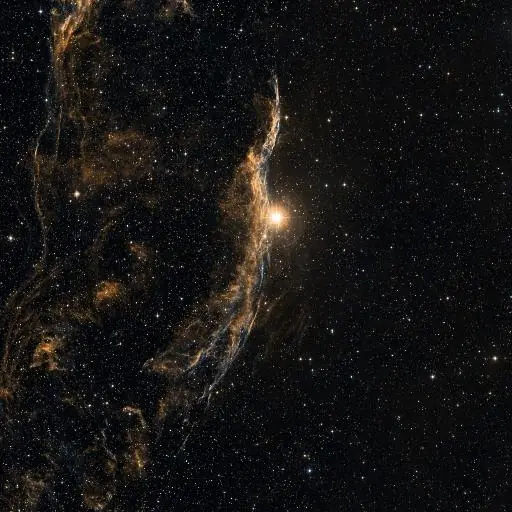
The Witch’s Broom: a strand of wreckage from a star that blew apart around the end of the last Ice Age.
Somewhere between 10,000 and 20,000 years ago, a star about 20 times the mass of the Sun blew itself apart in Cygnus. For a time it outshone Venus, bright enough to see in daylight. Our ancestors, living around the end of the last Ice Age, could have watched it blaze and fade.
The wreckage is still flying outward. Its glowing edges form the Cygnus Loop, a supernova remnant, and the Western Veil is one long strand of it. William Herschel found it on 5 September 1784, noting that it “passes thro’ 52 Cygni” and runs nearly two degrees. That star is only a bystander, far in the foreground.
Why does it look like a wisp of rope rather than a cloud? The shock front is a vast, thin shell, and we only see it brightly where we look along its surface edge-on — like the rim of a soap bubble. Ripples in the shell make the strands seem to twist around each other.
West Veil Nebula (NGC 6960) is 2,400 light-years away: the light we see from it set off around 380 BC, around the time the Parthenon was dedicated in Athens.
Did you know?
- Many names. Its long, sweeping shape with a bright star at one end gives it the nickname Witch’s Broom. It also goes by the Lacework Nebula and the Filamentary Nebula.
- Thinner than thin. Each glowing strand is a shock front less than one fifty-thousandth as thick as the shell’s radius — so thin that we only notice it when we look along it.
How big is it?
12 times the distance from the Sun to the nearest star. Light itself takes 49 years to cross it. Shrink our Solar System — the Sun and all eight planets — to the size of a coin, and the West Veil Nebula would be 1.23 km across (a 15-minute walk); the nearest star would be a football pitch away, and the Milky Way 2,520 km across.
The western arc of the Veil Nebula, running through the 4th-magnitude star 52 Cygni; an OIII filter turns it into a sharp, wispy filament, the Witch's Broom.
When and where to see it
It is best placed in the evening sky around September, when it crosses the meridian at about 10 pm local time (around midnight in August). It can be seen from everywhere north of 59°S and never sets north of 59°N.
At its highest it stands 71° up from 50°N, 86° up from 35°N, 59° up from the equator, 24° up from 35°S.
Facts
- Type
- Supernova remnant
- Constellation
- Cygnus
- Designations
- NGC 6960, C 34, Veil Nebula, Filamentary Nebula, Western Veil, Witch's Broom Nebula
- Magnitude
- 7.0 (blue)
- Apparent size
- 1.2° × 6.0′
- Position
- RA 20h 46.0m, Dec +30° 36′ (J2000)
- Distance
- 2,400 light-years
- Discovered
- William Herschel, 1784
Open AstroPilot to see when West Veil Nebula (NGC 6960) is highest tonight from your location, how easy it is with your telescope or binoculars, and an eyepiece view.