Fireworks Galaxy (NGC 6946)
Fireworks Galaxy (NGC 6946) is a galaxy in the constellation Cygnus, magnitude 9.1, 11′ × 11′ across.
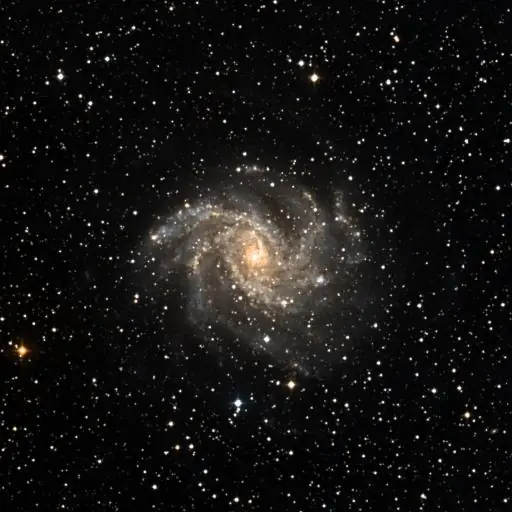
A galaxy where stars keep exploding — and where one giant star may have quietly vanished into a black hole.
Stars keep exploding in this galaxy. In 1917 George Willis Ritchey spotted a new star in this face-on spiral: a supernova, the first of ten seen here in a century. That is about ten times the Milky Way’s rate, even though our galaxy has twice as many stars, and for a time no galaxy had shown more — until NGC 3690 overtook it.
The reason is a boom in star birth. NGC 6946 is a starburst galaxy, forming new stars at a furious pace, and its most massive stars die young and violently. Its arms are full of oddities, from the giant “Red Ellipse” bubble to Hodge’s Complex, once thought to be a young star cluster and now suspected to be a small galaxy seen against it.
Then there is the star that disappeared. In 2009 a yellow hypergiant here brightened to over a million times the Sun’s luminosity, then faded away. Hubble finds no sign that it survived: it may have collapsed into a black hole without a proper explosion.
Fireworks Galaxy (NGC 6946) is 25 million light-years away: the light we see from it set off about 25 million years ago, when the Himalayas and the Alps were rising.
Did you know?
- An amateur’s supernova. SN 2017eaw was found on 14 May 2017 by Patrick Wiggins, an amateur astronomer in Utah. Its star turned out to be a red supergiant about 15 times the mass of the Sun.
- Caught before it blew. For SN 2004et, astronomers found the doomed star on older images — only the seventh time a supernova had been traced back to the star that exploded.
How big is it?
83% of the Milky Way’s width. Light itself takes 83,000 years to cross it. Shrink it to the length of a football pitch and our whole Solar System would be smaller than a bacterium.
A face-on spiral on the Cepheus–Cygnus border, named for its frequent supernovae (about ten seen since 1917). Dimmed by Milky Way dust, it needs dark skies.
When and where to see it
It is best placed in the evening sky around August, when it crosses the meridian at about 10 pm local time (around midnight in July). It can be seen from everywhere north of 30°S and never sets north of 30°N.
At its highest it stands 80° up from 50°N, 65° up from 35°N, 30° up from the equator, below the horizon from 35°S.
Facts
- Type
- Galaxy
- Constellation
- Cygnus
- Designations
- NGC 6946, C 12
- Magnitude
- 9.1
- Apparent size
- 11′ × 11′
- Position
- RA 20h 34.9m, Dec +60° 9′ (J2000)
- Distance
- 25 million light-years
- Discovered
- William Herschel, 1798
Open AstroPilot to see when Fireworks Galaxy (NGC 6946) is highest tonight from your location, how easy it is with your telescope or binoculars, and an eyepiece view.