NGC 6940
NGC 6940 is an open cluster in the constellation Vulpecula, magnitude 6.3, 11′ across.
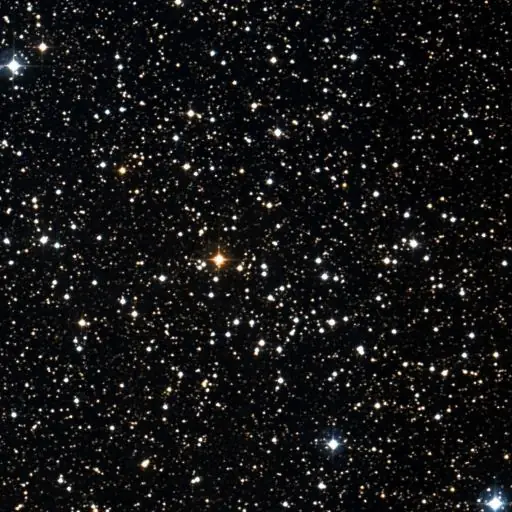
The finest cluster in Vulpecula — a billion-year-old crowd led by a slowly flickering red giant.
Of all the open clusters in Vulpecula, NGC 6940 is considered the finest. It has hundreds of members and is about a billion years old, old enough that its leading stars have swollen into red giants. More than 20 are known, and the brightest, FG Vulpeculae, slowly brightens and fades over about 80 days.
Some of its stars are close pairs whose tight orbits keep them spinning fast, so they stay magnetically active and glow in X-rays despite the cluster’s age. William Herschel found this open cluster in 1784.
NGC 6940 is 3,300 light-years away: the light we see from it set off around 1280 BC, around the time Tutankhamun was buried in the Valley of the Kings.
How big is it?
Born about 1.3 billion years ago, when there were no animals on Earth at all. Light itself takes 10 years to cross it. Gaia has picked out 864 stars moving together through space as its members. That’s 2.4 times the distance from the Sun to the nearest star. Shrink our Solar System — the Sun and all eight planets — to the size of a coin, and NGC 6940 would be 262 m across (2 football pitches end to end); the nearest star would be a football pitch away, and the Milky Way 2,520 km across.
A 6.3-magnitude open cluster in Vulpecula, about 11′ across.
When and where to see it
It is best placed in the evening sky around August, when it crosses the meridian at about 10 pm local time (around midnight in July). It can be seen from everywhere north of 62°S and never sets north of 62°N.
At its highest it stands 68° up from 50°N, 83° up from 35°N, 62° up from the equator, 27° up from 35°S.
Facts
- Type
- Open cluster
- Constellation
- Vulpecula
- Designations
- NGC 6940
- Magnitude
- 6.3
- Apparent size
- 11′
- Position
- RA 20h 34.4m, Dec +28° 17′ (J2000)
- Distance
- 3,300 light-years
- Discovered
- William Herschel, 1784
Open AstroPilot to see when NGC 6940 is highest tonight from your location, how easy it is with your telescope or binoculars, and an eyepiece view.