NGC 6939
NGC 6939 is an open cluster in the constellation Cepheus, magnitude 7.8, 12′ across.
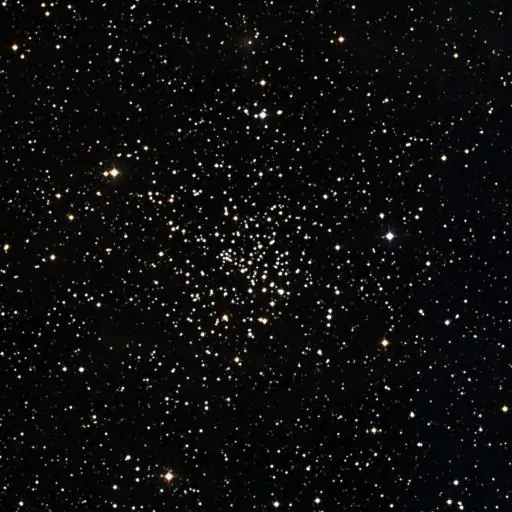
An old star cluster that shares a field of view with the Fireworks Galaxy, far beyond it.
Two hazy patches sit side by side near the border of Cepheus and Cygnus. One is NGC 6939, a cluster of stars in our own galaxy. The other is NGC 6946, the Fireworks Galaxy, a whole spiral galaxy far beyond, famous for its many supernovae. Their meeting is pure perspective.
NGC 6939 is old for an open cluster, between 1 and 1.3 billion years, and lies well above the plane of the Milky Way. William Herschel found it in 1798.
NGC 6939 is 5,900 light-years away: the light we see from it set off around 3880 BC, 670 years before writing was invented in Mesopotamia.
How big is it?
Born about 1.7 billion years ago, when there were no animals on Earth at all. Light itself takes 21 years to cross it. Gaia has picked out 1,175 stars moving together through space as its members. That’s 4.9 times the distance from the Sun to the nearest star. Shrink our Solar System — the Sun and all eight planets — to the size of a coin, and NGC 6939 would be 520 m across (5 football pitches end to end); the nearest star would be a football pitch away, and the Milky Way 2,520 km across.
A 7.8-magnitude open cluster in Cepheus, about 12′ across.
When and where to see it
It is best placed in the evening sky around August, when it crosses the meridian at about 10 pm local time (around midnight in July). It can be seen from everywhere north of 29°S and never sets north of 29°N.
At its highest it stands 79° up from 50°N, 64° up from 35°N, 29° up from the equator, below the horizon from 35°S.
Facts
- Type
- Open cluster
- Constellation
- Cepheus
- Designations
- NGC 6939
- Magnitude
- 7.8
- Apparent size
- 12′
- Position
- RA 20h 31.5m, Dec +60° 40′ (J2000)
- Distance
- 5,900 light-years
- Discovered
- William Herschel, 1798
Open AstroPilot to see when NGC 6939 is highest tonight from your location, how easy it is with your telescope or binoculars, and an eyepiece view.